Chase
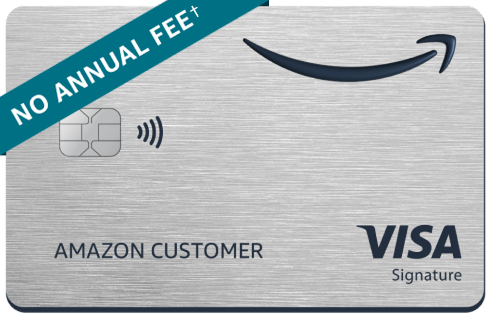
Amazon Visa
Earn 3% at Amazon and Chase Travel, 2% at gas and restaurants, 1% everywhere else. No annual fee and $50 welcome bonus.
Annual fee
None
Top rate
3x online shopping
Welcome bonus
$50
Quick look
Prime shopping rewards
Earn 3% at Amazon.com with no annual fee
3.7
out of 5
Rewards
Fees
Welcome bonus
Perks
Value
Overall score is a weighted average: Rewards 20% · Fees 20% · Welcome bonus 20% · Perks 20% · Value 20%.
Ideal for
Customers who spend $3,000+ annually at Amazon and Whole Foods, value simplicity over category rotation, and want to avoid an annual fee.
The verdict
The Amazon Visa works exactly as advertised: a no-fee way to earn rewards on Amazon purchases. For someone who spends $3,000+ annually at Amazon or Whole Foods, the 3% rate (and companion 2% categories) delivers genuine value. The instant $50 Amazon Gift Card bonus requires no spending threshold, which is convenient. But the card doesn't pretend to be a general-purpose rewards card—it's built for Amazon loyalty, and that specialization is both its strength and its limitation.
If you're not an Amazon regular, there are broader no-fee alternatives: Chase Freedom Flex rotates 5% categories, Discover it Chrome matches first-year rewards, and Capital One Quicksilver offers flat-rate flexibility. The Amazon Visa is a single-purpose tool that works well only if the purpose matches your spending.
Pros
- No annual fee with solid 3% Amazon rewards rate, plus 2% at gas and restaurants — meaningful earning without the cost.
- Instant $50 Amazon Gift Card upon approval with no minimum spending, unlike competitor welcome offers tied to $500+ spend thresholds.
- Travel protections bundled in (auto rental collision damage waiver, travel accident insurance) despite zero annual fee.
- Straightforward earning structure — no rotating categories or enrollment required.
Cons
- $50 welcome bonus is weak by market standards; competitors offer $200-$300 for similar or lower annual fees.
- Limited appeal outside Amazon and Whole Foods; generic 1% cash back on most everyday purchases.
- Only 3% at Amazon (not 5%) unless you qualify for a Prime-specific variant — and the card doesn't include Prime membership.
- Higher APR range (18.74%-27.49%) with a $500 minimum credit limit; this is a pay-in-full card, not a carry-balance option.
Reward rates
| Category | Rate | Details |
|---|---|---|
| Online shopping | 3x | 3% back at Amazon.com and on Chase Travel purchases |
| Dining & restaurants | 2x | 2% back at gas stations, restaurants, and on local transit |
| Gas & EV charging | 2x | 2% back at gas stations, restaurants, and on local transit |
| Everything else | 1x | 1% back on all other purchases |
The Amazon Visa concentrates its earning power at a single retailer—3% at Amazon and Whole Foods is the card's primary value proposition. That rate ranks 19th in the online shopping category across our full catalog; it's solid but not top-tier (premium shopping cards go up to 7-10% at specific merchants). The secondary 2% categories (gas, restaurants, transit) are serviceable middle-of-the-pack rates, but they're incidental to the card's core appeal. The 1% catch-all is the standard floor. Net: this is a specialist card, not a generalist. Value hinges entirely on whether your largest category of spending aligns with Amazon's footprint.
Fees and APR
Does it pay for itself?
Zero annual fee is rare and valuable—on a 5-year horizon, you're saving roughly $150-250 versus cards charging $75-95 annually. The card includes legitimate travel insurance (auto rental collision waiver, accident coverage) despite this price point, which makes the no-fee structure even more competitive. You're not sacrificing meaningful perks for the low cost.
Welcome bonus
Is it worth chasing?
The $50 Amazon Gift Card loads instantly upon approval with zero minimum spend—no hitting a $500 spend threshold or waiting for a statement credit. That instant gratification has real appeal for someone who wasn't going to manufacture spending just to unlock a bonus. However, $50 is objectively modest. Competitors offer $200-300 in credits or match-incentives for overlapping annual fees. This card's bonus is pitched at convenience and accessibility, not generosity.
Similar cards
Earn 5% at Amazon if you have Prime membership, with a $150 welcome bonus—but Prime subscription ($139/year) adds significant cost that the Amazon Visa avoids.
Rotating 5% categories plus a flat 1% (vs. Amazon's fixed categories)—better for variable spending, but lacks Amazon's specialized rate and carries no annual fee either.
Frequently asked questions
Does this card come with Amazon Prime membership?
No. The Amazon Visa earns 3% at Amazon regardless of Prime status. There's a separate Prime Visa that offers 5% to Prime members, but Prime itself ($139/year) is a subscription you buy separately. This card is a standalone option for both Prime and non-Prime customers.
How does the $50 welcome bonus actually work?
Upon approval, Chase automatically loads $50 as an Amazon Gift Card into the email account associated with your application. No spending requirement, no waiting for a statement credit—it's instant and ready to spend immediately.
Is this better than a general 2% cash back card like Citi Double Cash?
Only if you spend heavily at Amazon. If your top spending categories are Amazon, Whole Foods, gas, and restaurants, the 2-3% rates beat Citi's flat 2%. If you spread spending across travel, subscriptions, or categories outside those four, a flat-rate card is simpler and potentially better value.
What's the APR, and can I use this card if I carry a balance?
APR ranges from 18.74% to 27.49% depending on your creditworthiness. This card assumes you'll pay your balance in full monthly—carrying a balance will erode all rewards value within months of interest charges. Don't use this as a carry-balance card.
Are there travel perks despite the zero annual fee?
Yes. The card includes auto rental collision damage waiver, travel accident insurance, and extended warranty protection—benefits normally found on fee-bearing cards. It won't replace a premium travel card, but the coverage is a meaningful add-on for a no-fee product.
Reviewed by YoungerFinance Editorial · Last updated August 11, 2026