Bank of America
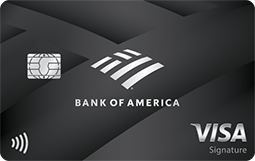
Bank of America Premium Rewards Credit Card
Premium rewards card with unlimited 2x points on travel and dining, plus travel statement credits, premium protections, and no foreign transaction fees.
Annual fee
$95
Top rate
2x flights
Welcome bonus
60,000 points
Quick look
2x Points on Travel & Dining
Earn unlimited rewards on your everyday spend
4.0
out of 5
Rewards
Fees
Welcome bonus
Perks
Value
Overall score is a weighted average: Rewards 20% · Fees 20% · Welcome bonus 20% · Perks 20% · Value 20%.
Ideal for
Frequent travelers and diners who bank with Bank of America and carry Preferred Rewards status, or anyone willing to maximize the $100 airline incidental and TSA PreCheck credits to justify the annual fee.
The verdict
The Bank of America Premium Rewards Credit Card appeals to frequent travelers and diners who already bank with BofA. The 2x points on travel and dining, combined with airline incidental and TSA PreCheck credits, create a useful travel toolkit for the $95 fee—and the 60,000-point welcome bonus nearly offsets the first-year cost. But here's the catch: the rewards rates are solidly middle-of-the-road for a premium card. You'll earn less per dollar in its key categories than co-branded airline cards or category-specific premium alternatives. The card makes sense only if you maximize the travel credits or carry large balances in bonus categories; otherwise, you're paying for benefits you may not use.
The very high APR (19.49–27.49%) with no intro period is another warning flag. If you carry a balance, this card gets expensive fast. It's best for disciplined spenders who pay off the statement each month and actually book flights or dine out enough to justify the annual fee.
Pros
- No foreign transaction fees, valuable for international travel without extra costs
- Airline incidental and TSA PreCheck/Global Entry credits offset part of the annual fee if used
- Straightforward 2x/1.5x earning structure that works across most everyday categories
- Bank of America Preferred Rewards customers can boost earnings up to 75%, multiplying points value
Cons
- Rewards rates rank middle-of-the-pack: 51st on flights, 45th on dining vs. 161 cards in catalog
- Very high APR with no introductory rate makes carrying a balance costly
- Travel and dining rates (2x) are standard for premium cards; you'll earn less than co-branded airline cards
- Requires roughly $4,750+ annual spend in bonus categories just to break even on the $95 fee
Reward rates
| Category | Rate | Details |
|---|---|---|
| Flights | 2x | 2 points per $1 on travel purchases |
| Dining & restaurants | 2x | 2 points per $1 on dining purchases |
| Everything else | 1.5x | 1.5 points per $1 on all other purchases |
The 2x on travel and dining is competitive at face value, but the catalog shows 50 cards beating this rate on flights and 44 on dining. For everyday purchases at 1.5x, you're ranked 28th—solid but not exceptional. The real value comes from chaining travel credits with bonus category spending, or taking advantage of BofA Preferred Rewards status (which adds 25–75% bonus points on top). Without either, you're paying $95 annually for rewards that don't diverge much from no-fee cards.
Fees and APR
Does it pay for itself?
The $95 fee sits squarely in the mid-premium range—33 other cards in your fee band, from co-branded airline cards to travel-focused alternatives. Whether it pays for itself hinges on the travel credits. If you use both the $100 annual airline incidental credit and the $100 TSA PreCheck/Global Entry credit (once every four years), you're covering a meaningful chunk of the fee. For diners and travelers, the earning structure adds incremental value, but discipline is required: carry a balance and the high APR will erase rewards gains.
Welcome bonus
Is it worth chasing?
The 60,000-point welcome bonus ($600 value) is genuinely generous and lands near the top of cash-back and travel card offers. You'll need $4,000 in spending over three months to unlock it—reasonable for a premium card and achievable during normal seasonal spend. For BofA Preferred Rewards members, this bonus scales up to 75%, unlocking up to $1,050 in value. This nearly covers a full year's annual fee, making it a strong incentive for new applicants. However, the bonus size alone doesn't elevate the card's overall value if you don't sustain high spending afterward.
Other benefits
- Up to $100 in Airline Incidental Statement Credits annually
- Up to $100 in TSA PreCheck or Global Entry credit every four years
- Travel insurance protections including trip delay, cancellation, and baggage coverage
- Purchase protections including warranty manager, return protection, and purchase security
- 24/7 Roadside Dispatch Program and auto rental collision damage waiver
- Visa Signature Luxury Hotel Collection benefits
- Visa Signature concierge service for travel planning and restaurant recommendations
- No foreign transaction fees
- $0 Liability Guarantee for fraudulent transactions
- Balance Connect overdraft protection
- Digital wallet compatibility with Apple Pay, Google Pay, and Samsung Pay
Similar cards
Similar $95 fee and 2x dining, but Hyatt earns 4x on Hyatt stays and 2x on flights—better if you stay at chain hotels
Same $95 fee with 10x travel points, but lacks Citi's breadth of benefits and offers less flexibility on dining
Frequently asked questions
How much do I need to spend to break even on the $95 annual fee?
Assuming a redemption value of $0.01 per point and earning 2x in bonus categories, you'd need roughly $4,750 annual spend to earn $95 in pure points value. The airline incidental credit ($100) and TSA PreCheck/Global Entry credit ($100 every four years) help close the gap, especially if you actually book flights or travel. Below $4,000–5,000 combined annual spend in travel and dining, the fee becomes harder to justify.
Does this card have a 0% introductory APR period?
No. The card carries a variable APR of 19.49–27.49% with no intro period for purchases or balance transfers. This is notably high and a serious risk if you plan to carry a balance. Only apply if you'll pay off your statement in full each month.
Can I stack the airline credit with the TSA PreCheck credit?
Yes. You get up to $100 per year in airline incidental charges (seat upgrades, luggage fees, lounge access), plus a separate $100 TSA PreCheck or Global Entry credit every four years. Both credits are automatic statement credits when you pay with the card. Together, they offset a meaningful portion of the annual fee for frequent travelers.
Is this card worth it if I'm not a Bank of America customer?
It's possible, but less compelling. Non-BofA customers earn the base 2x and 1.5x rates with no multiplier. The travel credits and welcome bonus help, but you'd need to be a heavy travel and dining spender to justify the $95 fee. If you're not already with BofA and don't prioritize their Preferred Rewards program, compare this against cards like the Citi Strata Premier or World of Hyatt, which offer similar perks without the BofA ecosystem requirement.
How valuable is the welcome bonus really?
The 60,000 points carry a stated $600 value, which roughly tracks if you redeem for travel through BofA's portal (averaging $0.01 per point). For Preferred Rewards members earning an extra 25–75% on the bonus, it climbs to $750–1,050. This nearly covers the first-year fee, making it a solid incentive. However, sustainable value depends on post-bonus spending; earning the bonus is just the entry fee to justifying the $95 annual cost long-term.
Reviewed by YoungerFinance Editorial · Last updated August 10, 2026