Bank of America
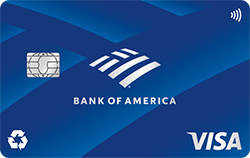
Bank of America Travel Rewards Secured Credit Card
Build credit with unlimited 1.5x rewards on all purchases, no annual fee, and no foreign transaction fees. Requires $200-$5,000 security deposit.
Annual fee
None
Top rate
1.5x everything else
Credit needed
Fair (580-669)
Quick look
Build Credit While Earning
1.5x unlimited points on all spending, no annual fee
3.0
out of 5
Rewards
Fees
Welcome bonus
Perks
Value
Overall score is a weighted average: Rewards 20% · Fees 20% · Welcome bonus 20% · Perks 20% · Value 20%.
Ideal for
People rebuilding credit who want to earn rewards in the process, and who can reliably pay balances in full each month.
The verdict
This card occupies a rare middle ground: it's a secured card that actually rewards spending, not just a credit-building timeout. The 1.5x rate on everything is solid for a secured product, and no annual fee means it won't drain the limited funds of someone rebuilding. The catch is real—27.49% APR and a security deposit cap your credit line—but for someone determined to rebuild credit while earning something in the process, it's one of the more useful options out there. Skip this if you already have good credit; the unsecured Travel Rewards card is superior in every way.
The no-foreign-transaction-fee angle gets marketed heavily, but for a credit-rebuilding audience, that's a feature, not a core value prop. The realistic scenario: use it lightly for groceries and utilities, pay it off monthly, watch your credit improve, then graduate to a proper travel card.
Pros
- Unlimited 1.5x points on all purchases—rare earnings diversity on a secured card
- No annual fee or foreign transaction fees, unlike most travel cards
- Security deposit returns after demonstrating responsible usage, giving a clear path to unsecured status
Cons
- 27.49% APR is punishing if you carry even small balances, which defeats the earning appeal
- No welcome bonus—secured applicants get no head start on rewards, unlike unsecured travel cards
- Credit limit equals your deposit, so a $1,000 limit caps your spending unless you tie up $5,000
Reward rates
| Category | Rate | Details |
|---|---|---|
| Everything else | 1.5x | Earn unlimited 1.5 points for every $1 you spend on all purchases everywhere |
1.5x on everything puts this 28th in the catalog by earning rate—solid middleground for a secured card, but miles behind premium travel cards. The real value isn't chasing maximum points; it's proving you can earn and manage rewards responsibly while rebuilding credit. Points don't expire, and you can redeem them toward travel purchases at 1¢ per point minimum.
Fees and APR
Does it pay for itself?
Free annual fee is exceptional for any credit card. The true cost is the 27.49% APR, which is typical for secured products but becomes destructive instantly if you carry a balance. The implied calculus: this card is only worthwhile if you pay in full, every month, without exception.
Other benefits
- $0 Liability Guarantee for fraudulent transactions
- No foreign transaction fees
- Fraud detection and prevention
- Balance Connect for overdraft protection (no transfer fees, other fees may apply)
- Paperless statement option
- Digital Wallet Technology (Apple Pay, Google Pay, Samsung Pay)
- Online and Mobile Banking access
- Account Alerts for balance and due dates
- Better Money Habits financial education
- Security deposit can be returned after demonstrating responsible credit usage
- Eligible for BofA Rewards program bonus on credit card purchases
Similar cards
If you've rebuilt credit enough to qualify—this unsecured sibling offers the same 1.5x everywhere with a $250 welcome bonus, and no deposit tying up cash.
Another secured option for rebuilding credit, but with 1.5% cash back instead of points and a simpler redemption path.
Frequently asked questions
When can I get my security deposit back?
Bank of America doesn't publish exact timelines, but they indicate it's possible after demonstrating responsible credit usage—typically 6–18 months of on-time payments and healthy credit habits. There's no guarantee; approval depends on your credit improvement and account standing. Once approved for graduation, you'll transition to the unsecured version and your deposit becomes available.
How do I redeem my points?
Points are redeemable toward travel purchases made through your Bank of America account, counting flights, hotels, rental cars, and cruises. Redemptions start at 2,500 points, valued at 1¢ per point minimum. If you have a qualifying Bank of America checking account, you can earn a 50% rewards bonus, boosting your rate to up to 2.25x depending on your account tier.
Will this card help me build credit?
Yes, in the same way any credit card does: by reporting your account activity to the three major credit bureaus. The key is consistent, on-time payments and low utilization. Since your credit limit equals your deposit, keeping utilization low is easier—just don't spend more than 30% of your deposit in a given month.
What's the difference between this and the regular Bank of America Travel Rewards card?
The secured version requires a deposit, has no welcome bonus, and is designed for fair credit. The unsecured version requires better credit, offers a $250 welcome bonus, and has no deposit requirement. If you qualify for the unsecured version, it's a better deal. This card is your stepping stone to get there.
Reviewed by YoungerFinance Editorial · Last updated August 10, 2026