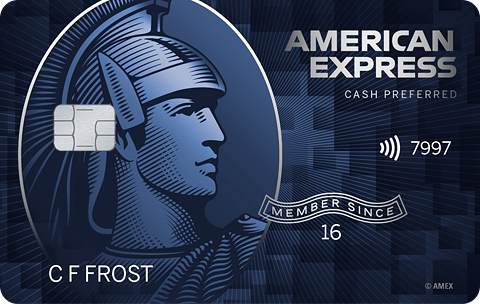
American Express
Blue Cash Preferred Card
American Express Blue Cash Preferred offers up to 6% cash back on groceries and streaming subscriptions, plus 3% on transit and gas. Welcome bonus up to $300 cash back.
Annual fee
$95
Top rate
6x groceries
Welcome bonus
$300
Quick look
Highest Cash Back on Groceries
6% cash back at U.S. supermarkets up to $6,000/year
4.0
out of 5
Rewards
Fees
Welcome bonus
Perks
Value
Overall score is a weighted average: Rewards 20% · Fees 20% · Welcome bonus 20% · Perks 20% · Value 20%.
Ideal for
Grocery shoppers spending $500+ monthly at supermarkets who also pay for streaming services and want to maximize everyday earning without traveling internationally.
The verdict
The Blue Cash Preferred is a specialist card for households that revolve around groceries and streaming. At 6% cash back on supermarket purchases and 6% on streaming subscriptions—both among the highest rates in the catalog—it delivers genuine value for those bonus categories. The $95 annual fee (waived the first year) breaks even quickly for anyone hitting the $6,000 supermarket cap, and the 0% intro APR on purchases and balance transfers for 12 months adds real utility. But those perks come with real limitations: non-bonus spending earns just 1%, it lacks protections or credits that justify its premium tier, and at 2.7%, the foreign transaction fee and limited Amex acceptance make it a poor choice for travelers. It's a card that knows what it does—reward the everyday essentials—and does it well, as long as that matches your actual spending.
Don't mistake it for a flexible travel card or a generalist rewards machine. Pick it only if groceries and streaming are genuine spending anchors in your budget.
Pros
- Best-in-class 6% cash back on U.S. supermarket purchases—tied for top rate in the entire catalog
- Matching 6% on select streaming subscriptions, nearly double most competitors
- 0% intro APR for 12 months on purchases and balance transfers, useful for balance consolidation
- Welcome bonus of $300 cash back offsets the first year's annual fee entirely
- Solid 3% cash back on gas and transit, covering essential commuting expenses
Cons
- $95 annual fee requires active use—skip it if you don't hit the grocery or streaming categories regularly
- Supermarket rewards capped at $6,000 per year (then 1%)—high-volume grocery shoppers max out quickly
- Only 1% cash back on purchases outside bonus categories, leaving general spending reward-poor
- 2.7% foreign transaction fee makes international travel costly; Amex has narrower acceptance globally
- No sign-up protections, purchase protection, or travel credits—fees don't buy perks
Reward rates
| Category | Rate | Details |
|---|---|---|
| Groceries | 6x | At U.S. supermarkets, on up to $6,000 per year in purchases (then 1%) |
| Streaming | 6x | On select U.S. streaming subscriptions |
| Flights | 3x | On transit including taxis, rideshare, parking, tolls, trains, buses, and more |
| Gas & EV charging | 3x | At U.S. gas stations |
| Everything else | 1x | On other eligible purchases |
The 6% on groceries ranks joint-first in the entire catalog, tied with the Hilton Honors Surpass. But Amex caps that rate: you earn 6% only on the first $6,000 per calendar year, then 1% thereafter. That ceiling is real—a household spending $800/month at supermarkets ($9,600 yearly) hits the cap by October. The 6% on streaming is the second-best rate available, behind only the Disney Inspire card's 10%, and it applies to a category most cardholders use actively. Gas and transit at 3% rank 8th in gas and 24th in flights, solid but not exceptional; the catch-all 1% on everything else is unremarkable.
Fees and APR
Does it pay for itself?
After the welcome bonus year ends, the $95 annual fee kicks in. Breakeven math: earn $95 in value to justify the fee. At 6% on groceries, you need $1,583 in supermarket spending per year (about $132/month) to cover it—low enough that most households hit it in a few months. If you also use the streaming bonus and hit gas/transit, the fee pays for itself almost automatically. But if your bonus-category spending is light, alternatives like the no-fee Blue Cash Everyday (3% groceries) or Chase Freedom Flex start looking better.
Welcome bonus
Is it worth chasing?
$300 is a solid midrange welcome offer. The requirement—$3,000 in purchases within six months—is modest by premium standards and easy for most new applicants to hit in ordinary spending, especially with the first-year fee waiver sweetening the pot.
Similar cards
Comparable $95 fee and solid welcome bonus, but rewards points instead of cash and adds travel protections and dining credits—better for flexible travel spending
$95 same fee bracket with similar rewards breadth, but earns points on travel and entertainment instead—consider if you prioritize airline/hotel transfers
Frequently asked questions
Is the $95 annual fee really worth it?
Yes, if you spend more than $1,600/year at supermarkets (just over $130/month). Most households hit that easily—6% cash back on $1,600 is $96, covering the fee. Add streaming and gas, and the math becomes even clearer. But if your grocery budget is under $100/month, the no-fee Blue Cash Everyday might be better.
How does the $6,000 supermarket spending cap work?
You earn 6% on supermarket purchases up to $6,000 per calendar year. Once you hit $6,000, all further supermarket spending earns only 1% for the rest of that year. Track your spending or set a calendar reminder around mid-year to know when you'll hit the cap.
Can I use this card for international travel?
You can, but it's not ideal. The 2.7% foreign transaction fee on overseas purchases is above average, and American Express has narrower acceptance than Visa or Mastercard in many countries. If travel is a priority, the Chase Sapphire Preferred (no foreign fee) or Citi Strata Premier (transfer partners for flights/hotels) are stronger picks.
What can I do with the 0% intro APR for 12 months?
Use it to consolidate credit card debt at no interest for a year—ideal if you're paying high rates elsewhere. You can also use it as a spending float if you pay off the full balance monthly and want a long interest-free period, though that's not why most people get the card.
How does this compare to the Blue Cash Everyday Card?
The Everyday has no annual fee but maxes out at 3% cash back on supermarkets (not 6%) and requires 25+ transactions monthly to avoid a $25 annual fee anyway. If you spend under $2,500/year on groceries, the Everyday costs less. But higher spenders come out ahead with the Preferred's superior rates.
What credit score do I need to get approved?
American Express typically requires good to excellent credit (740+) for approval, though some applicants with scores in the 700–739 range have reported success. Check your score before applying; Amex is selective about new cardholders.
Reviewed by YoungerFinance Editorial · Last updated August 11, 2026