Chase
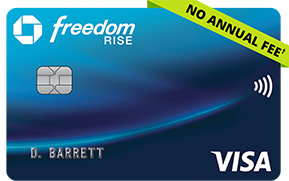
Chase Freedom Rise Credit Card
No annual fee card designed for students and those new to credit. Earn 3% cash back on dining and 1.5% on all other purchases, plus a $25 bonus for autopay enrollment.
Annual fee
None
Top rate
3x dining & restaurants
Welcome bonus
$25
Quick look
Built for Building Credit
Start earning rewards while establishing your credit history
3.5
out of 5
Rewards
Fees
Welcome bonus
Perks
Value
Overall score is a weighted average: Rewards 20% · Fees 20% · Welcome bonus 20% · Perks 20% · Value 20%.
Ideal for
Students and credit newcomers who need a no-deposit, no-fee card to establish credit history.
The verdict
The Chase Freedom Rise is a rare no-fee card that doesn't pretend to be something it isn't. It earns a flat 1.5% cash back on everything, with a temporary bump to 3% on dining for your first six months—modest, but honest. The real value lives in what the card *does for you*: it's designed to build credit without a security deposit, reports monthly to the bureaus, and Chase may let you upgrade to a better card after six months of responsible use. That's the play here, not the rewards. If you're new to credit or a student looking for a no-friction entry point, this works. Just don't expect to keep it long-term—it's a stepping stone, not a destination.
The catch is that 1.5% flat rate can't compete once you graduate to a real rewards card. Other issuers offer 2%, 2.5%, or category bonuses on the same card and same fee. The $25 autopay bonus barely registers, and the 3% foreign transaction fee makes international travel costly. For someone with established credit looking at their options, the Freedom Rise underperforms.
Pros
- No annual fee and no security deposit, removing barriers for credit builders
- Unlimited 1.5% cash back on all purchases—no categories to track, simple to earn
- Monthly credit bureau reporting supports credit score improvement over time
Cons
- Designed as a stepping stone, not a long-term card—rewards lag behind competitors
- 3% foreign transaction fee makes international spending expensive
- High APR (18.24%–27.74%) penalizes any carried balance
Reward rates
| Category | Rate | Details |
|---|---|---|
| Dining & restaurants | 3x | Earn 3% cash back on dining at restaurants, including takeout and delivery, on up to $6,000 spent in first 6 months |
| Everything else | 1.5x | Earn 1.5% cash back on all other purchases |
The 1.5% flat rate is straightforward—no rotating categories to manage. The 3% dining bonus lasts only six months and caps at $6,000 in spending (so max $180). After six months, you revert to 1.5% on everything. That's respectable for a no-fee starter card, but it won't compete with cards offering 2–2.5% flat rates, nor will it keep pace with category-heavy cards once your credit improves.
Fees and APR
Does it pay for itself?
No annual fee is the core value proposition. Chase doesn't charge you to hold the card or build credit with it. That's rare and matters.
Welcome bonus
Is it worth chasing?
The $25 autopay credit is minimal. It requires enrollment within three months of opening and is essentially a thank-you for paperless statements. Compare to competitors: Capital One's student card offers $100, Discover matches your first-year cash back, and the regular Freedom Unlimited offers $200 after spending. The $25 doesn't move the needle.
Similar cards
Better welcome bonus ($100) and same 3% dining rate, but less 1.5% baseline
Discover matches all your first-year cash back dollar-for-dollar—a significantly stronger welcome offer
Frequently asked questions
Can I upgrade to a better Chase card later?
Possibly. Chase reviews accounts on their anniversary date to see if you qualify for an upgrade to the Freedom Unlimited or Freedom Flex. There's no guarantee, but it's a real upgrade path if your credit improves.
How does the 3% dining bonus work?
It applies automatically during your first six months. After six months, the rate drops to 1.5%. The bonus is also capped at $6,000 in spending, so the maximum you can earn is $180 from that category alone.
Should I use this card internationally?
No. The 3% foreign transaction fee is high and will erode any rewards you earn abroad. Use a no-foreign-fee card (or cash) when traveling outside the U.S.
What happens if I carry a balance?
The APR (18.24%–27.74%) is high, which is typical for credit-builder cards aimed at higher-risk borrowers. Carrying a balance will quickly wipe out any cash-back earnings. Treat this as a pay-in-full card.
Reviewed by YoungerFinance Editorial · Last updated August 11, 2026