Chase
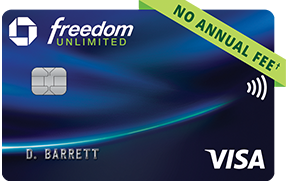
Chase Freedom Unlimited Credit Card
Earn unlimited 1.5% cash back on all purchases with a $200 sign-up bonus and no annual fee.
Annual fee
None
Top rate
5x flights
Welcome bonus
$200
Quick look
Unlimited 1.5% Cash Back
Earn cash back on everything you buy
3.8
out of 5
Rewards
Fees
Welcome bonus
Perks
Value
Overall score is a weighted average: Rewards 20% · Fees 20% · Welcome bonus 20% · Perks 20% · Value 20%.
Ideal for
Applicants with good-to-excellent credit (670+) who want a no-fee starting point, want to pair with other Chase cards for synergy, or prefer simplicity over category optimization.
The verdict
The Freedom Unlimited is Chase's workhorse cash-back card for people who want uncomplicated rewards without paying an annual fee. You earn 1.5% on everything, with bumps to 5% on travel booked through Chase Travel, 3% on dining, and 3% at drugstores. The $200 sign-up bonus is modest but easy to earn. There's no trick: no category rotation, no redemption minimums, and no annual fee. That simplicity is the whole sell.
The tradeoff is middling rankings across the board — you'll find better cash-back rates in specific categories on premium cards, and you're locked into the Chase ecosystem for travel redemptions (the 5% only applies when booking through Chase Travel, not on airline websites). The card works best as part of a broader Chase card strategy, where you can funnel points between accounts. Standalone, it's solid but unremarkable. Best for someone building credit or seeking a no-friction secondary card.
Pros
- No annual fee with straightforward 1.5% base rate makes it accessible and easy to justify
- 5% on Chase Travel bookings covers most flight and hotel bookings when you use the portal
- Can transfer Ultimate Rewards between other Chase cards, unlocking better redemption rates if you hold a premium card
- 0% APR on purchases and balance transfers for 15 months gives breathing room on larger balances
Cons
- 1.5% base rate ranks 21st in the catalog — better no-fee cards like Citi Double Cash and Capital One Venture exist
- Travel rewards locked behind Chase Travel portal; booking direct with airlines or hotels doesn't earn the 5%
- 3% foreign transaction fee is steep if you travel internationally, immediately erasing earnings
- Sparse benefits — no purchase protection, extended warranty, or travel insurance compared to premium competitors
Reward rates
| Category | Rate | Details |
|---|---|---|
| Flights | 5x | 5% cash back on travel through Chase Travel |
| Dining & restaurants | 3x | 3% cash back on dining and takeout |
| Drugstores | 3x | 3% cash back at drugstores |
| Everything else | 1.5x | 1.5% cash back on all purchases |
The 1.5% base rate is middle-of-the-pack among no-fee cards — better cards like Citi Double Cash (2%) and VentureOne (5% on all purchases) exist, though those have their own trade-offs. The 5% on Chase Travel is solid for planned bookings, but only works through Chase's booking portal. The 3% on dining and drugstores are in the middle tier; premium cards like Hilton Aspire hit 7% dining. Strength comes from category breadth and simplicity rather than top-tier rates.
Fees and APR
Does it pay for itself?
No annual fee is the biggest selling point. The card more than justifies its cost (or lack thereof) for casual spenders. Where it earns its value is in simplicity — there's nothing to activate, no rotating categories to track, and no fee to offset. For someone building credit or wanting a second everyday card, the zero-dollar entry point is hard to beat.
Welcome bonus
Is it worth chasing?
$200 after $500 spend in 3 months is modest but attainable — most people hit that in a single large purchase or weekly groceries plus dining. It's not exciting compared to premium card bonuses ($500+), but it's realistic and immediate value. Worth timing the application around a planned expense.
Similar cards
Sister card with rotating 5% categories and same base 1.5%, if you want to optimize by category
Competing no-fee card with 2% cash back across the board — simpler earning but no bonus categories
Frequently asked questions
How does the 5% travel earning work? Can I book with any airline or hotel?
The 5% applies only to flights, hotels, car rentals, and other travel booked through Chase's own travel portal. Direct bookings with airlines or hotel websites don't earn the rate. This limitation is meaningful — many travelers prefer booking direct or using alternative platforms for price flexibility.
Do I need an existing Chase account to apply?
No. You can apply as a new customer. However, Chase enforces a 5/24 rule: if you've opened 5 or more credit cards (not just Chase) in the past 24 months, Chase will likely deny you. This is an unofficial but strict policy.
Can I combine rewards with a partner card like Chase Sapphire Preferred?
Yes. Ultimate Rewards transfer between Chase cards you own, so pairing this with Sapphire Preferred or a business card lets you consolidate and transfer to airline and hotel partners for redemption rates of 1.25x or higher. That's where the true value emerges if you're willing to chase premium status elsewhere.
Is the 3% foreign transaction fee a deal-breaker for international travel?
It's a meaningful cost. If you travel internationally often, the fee immediately reduces your earnings. A dedicated travel card without foreign transaction fees (like Sapphire Preferred or even Venture X) is worthwhile if you spend significantly abroad.
How does this compare to simply getting Cash Back from my debit card?
Most debit cards offer 0% cash back. Even a flat 1.5% from this card beats that handily — $100 in quarterly groceries earns $18/year in cash back. The sign-up bonus ($200) is equivalent to 13+ months of baseline groceries earnings, making it worth applying for even if you only use it sporadically.
Reviewed by YoungerFinance Editorial · Last updated August 11, 2026