American Express
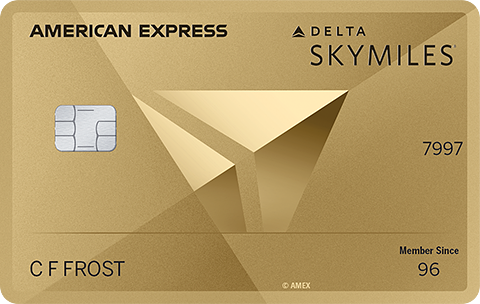
Delta SkyMiles Gold American Express Card
Delta co-branded card earning 2X miles on travel, dining and groceries, with $200 annual flight credit, free checked bags and priority boarding—ideal for frequent Delta travelers.
Annual fee
$150
Top rate
2x flights
Welcome bonus
$1,350
Quick look
Dual Annual Travel Credits
$200 Delta flight credit + $100 hotel stays credit annually
3.7
out of 5
Rewards
Fees
Welcome bonus
Perks
Value
Overall score is a weighted average: Rewards 20% · Fees 20% · Welcome bonus 20% · Perks 20% · Value 20%.
Ideal for
Frequent Delta travelers earning 2-4 round trips per year who want to convert dining and grocery spending into miles while enjoying free checked bags and priority boarding.
The verdict
The Delta Gold is a solid co-branded card for people who fly Delta a few times a year and want to convert everyday spending into miles. The $200 annual flight credit, free checked bags, and 2X earning on dining and groceries make the $150 fee defensible for this audience. But if you're loyalty-agnostic about airlines or only fly Delta once annually, the rewards rates rank in the middle of the catalog and the fee becomes a drag.
The card sits in a crowded segment—Southwest Rapid Rewards Premier and United Explorer are neighboring $150 options with different perks. Delta Gold wins if Delta's route network is your home base; otherwise, these competitors offer better value for their annual fees.
Pros
- Free checked bags save $90-100 per year for frequent flyers, and the $200 flight credit offsets most of the annual fee
- 2X miles on dining and supermarkets earning potential across three everyday spending categories
- 15% discount on Delta award flights (TakeOff 15) extends mile value for award bookings
- Priority Zone 5 boarding speeds up the travel day without premium cabin prices
Cons
- $150 annual fee is steep if you don't fly Delta at least twice a year
- 2X rewards rates rank mid-catalog in all categories—31st-40th place—not a standout earner vs. category leaders
- 20% in-flight credit maxes out at $60 annual value, only useful if you buy food and drinks on board
- Limited benefit if traveling with companions who don't hold the card; checked bag waiver only applies to the cardholder and immediate family
Reward rates
| Category | Rate | Details |
|---|---|---|
| Flights | 2x | 2X miles on Delta purchases made directly with Delta |
| Dining & restaurants | 2x | 2X miles at restaurants, including takeout and delivery in the U.S. |
| Groceries | 2x | 2X miles at U.S. supermarkets |
| Everything else | 1x | 1X mile per dollar on all other eligible purchases |
The 2X rate on dining, groceries, and Delta purchases sounds broad, but these categories rank 19th-40th in our catalog—solid but not leading. You'll earn miles on everyday purchases, but category specialists like Amex Gold (4X dining) or Blue Cash Preferred (6X groceries) out-earn this card on their specialized categories. The 1X base rate on everything else ranks 33rd of 100 cards.
Fees and APR
Does it pay for itself?
At $150, this card positions itself in the mid-premium range alongside Southwest Rapid Rewards Premier and United Explorer. The value case depends on Delta loyalty: the $200 annual flight credit, free first checked bag (worth $45-50 each way), and priority boarding create a meaningful offset. For someone flying Delta 2-3 times per year domestically, the fee clears. For infrequent Delta travelers, the fee outweighs the benefits.
Welcome bonus
Is it worth chasing?
The 90,000-mile welcome bonus requires $3,000 spend in 6 months and comes with no signup bonus cap. At an assumed 1.5-cent valuation, that's roughly $1,350 in award value—solid for a co-branded card, though not the highest in the airline card segment. The bonus is reachable for someone meeting $500/month average spend.
Similar cards
Similar $149 fee and airline focus. Southwest's 4 annual upgraded boardings and trip-disruption protection compete head-to-head; choose based on your home airport's carrier dominance.
$150 fee with United perks: higher lounge access ceiling and stronger domestic baggage allowance. Better for premium positioning; Delta Gold is simpler.
Frequently asked questions
Is the $150 annual fee worth it if I fly Delta twice a year?
Yes, in most cases. One round-trip means two checked bags (one each way), valued at $90-100 combined, plus the $200 annual flight credit covers most of the fee. If you also book Delta award flights, the 15% TakeOff 15 discount adds value. The breakeven is roughly 1-1.5 round trips per year for most travelers.
How does this compare to Southwest Rapid Rewards Premier?
Both are $150-ish annual fees for airline loyalists. Southwest's strength is frequent upgraded boardings (4 per year) and a culture built around checked-bag inclusion. Delta Gold's strength is earning miles on dining and groceries outside of flying. Choose Southwest if you live in a Southwest hub; choose Delta if you want strong everyday category earnings alongside airline perks.
Does this card work well for someone who doesn't fly Delta often?
No. If you fly other carriers more, or fly Delta once a year or less, the $150 fee quickly outweighs the benefits. A flat-rate rewards card or a general travel card like Chase Sapphire Preferred would serve you better. This card is built for Delta loyalists and frequent flyers.
What's the value of the $200 flight credit?
The $200 Delta flight credit applies to tickets, seat upgrades, and in-flight purchases booked on Delta. For most flyers taking at least one Delta trip per year, this covers a portion of the annual fee, making the net cost $0 or negative. If you fly multiple times, the credit renews annually.
Can I earn the 2X miles bonus on Delta.com purchases if I book through a travel agent?
The 2X miles on Delta purchases applies to tickets bought directly through Delta's website, phone, or airport counter. Third-party bookings or travel agent purchases typically earn 1X. Check Delta's terms for clarity, as bonus eligibility can shift.
Reviewed by YoungerFinance Editorial · Last updated August 11, 2026