American Express
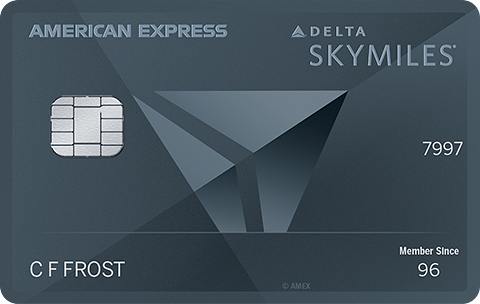
Delta SkyMiles Reserve American Express Card
Elite Delta co-branded card with premium lounge access, companion certificates, accelerated elite status benefits, and $800+ in annual travel credits.
Annual fee
$650
Top rate
3x flights
Welcome bonus
$1,875
Quick look
Premium Delta Rewards
3X miles on Delta flights plus Sky Club access
4.2
out of 5
Rewards
Fees
Welcome bonus
Perks
Value
Overall score is a weighted average: Rewards 20% · Fees 20% · Welcome bonus 20% · Perks 20% · Value 20%.
Ideal for
Frequent Delta flyers pursuing or maintaining Medallion elite status, particularly those in hubs like Atlanta or Minneapolis who use Sky Club lounges regularly.
The verdict
The Reserve works only if you're a Delta loyalist willing to spend the $650 annual fee. Its strength isn't earning rates—3X on Delta flights ranks 24th in the catalog, and 1X everywhere else is ordinary. Instead, this card is built around lounge access, elite status acceleration, and travel credits that can total $560+ annually. If you're chasing Medallion status or value airport lounges, the combination of 15 annual Sky Club visits, Centurion Lounge access, and a companion certificate valid for first/comfort cabin seating justifies the cost. If you fly Delta casually or prefer earning flexibility, the Platinum at half the fee offers better bang for dollar.
The gap between this and competitors is narrow. The Marriott Bonvoy Brilliant costs the same $650 but delivers broader earning (3X on flights and dining broadly, not just Delta); the United Club Infinite at $695 grants Lounge passes instead of Sky Club visits. This card's real advantage is the elite status boost—1 MQD per $10 spent, double the Platinum rate—which compounds if you're already working toward elite tier.
Pros
- Annual travel credits ($200 Delta Stays, $240 Resy dining, $120 ride-share) total $560 toward the annual fee, making the net cost manageable for active travelers
- 15 annual Sky Club visits plus Centurion Lounge access delivers premium airport experience without paying separately for membership
- Medallion status acceleration at 1 MQD per $10—double the Platinum rate—is a genuine advantage for frequent flyers pursuing elite tiers
- Companion certificate valid for first and Delta Comfort fares, not just main cabin, adds meaningful value over the Platinum
Cons
- Earning is narrowly focused: 3X only on Delta bookings, 1X on everything else, limiting flexibility for those who split airline loyalty
- $650 annual fee requires discipline to use all credits; forfeited monthly credits don't roll over
- Sky Club visits capped at 15 annually unless you spend $75,000+ on the card, creating a pay-to-upgrade scenario for heavy travelers
- Rank 24th in flight rewards and rank 33rd in everyday spending means competitive cards like United Quest (10X flights) earn substantially faster
Reward rates
| Category | Rate | Details |
|---|---|---|
| Flights | 3x | 3X miles on Delta purchases made directly with Delta |
| Everything else | 1x | 1X mile on all other eligible purchases |
The 3X rate on Delta-booked flights ranks solidly in the mid-tier (24th of 48 cards), but earns much slower than airline-specific cards like United Quest (10X). The 1X baseline on other purchases is standard and unremarkable. This card is a Delta specialist; if you value flexible earning across multiple airlines, the American Express Platinum or a flexible rewards card like Chase Sapphire Reserve would outpace it despite lacking co-brand perks.
Fees and APR
Does it pay for itself?
At $650, this fee is steep but defensible. The combination of $200 Delta Stays credit, $240 Resy dining credit ($20/month capped), $120 rideshare credit ($10/month), plus a free checked bag and priority boarding, totals approximately $560 in quantifiable value before lounge access. That leaves a true net cost of ~$90, which is absorbed by even moderate use of Sky Club lounges. For non-travelers or those outside Resy-covered markets, the fee becomes harder to justify.
Welcome bonus
Is it worth chasing?
The offer of up to 125,000 bonus miles—$6,000 in spend for 100,000 miles, plus $3,000 more for an additional 25,000—is solid but not exceptional for a $650-fee premium card. Third-party valuations peg 1,000 miles at $10-$15; realistic value is $1,000-$1,500 depending on redemption strategy. The minimum spend ($6,000 within 6 months) is achievable for someone seriously considering this card, though moderate. Compare to the Marriott Bonvoy Brilliant's 150,000-point bonus or the United Club Infinite's 80,000-mile offer with similar spending thresholds.
Similar cards
Lower $350 fee and broader earning (2X on dining/hotels), but no lounge access or elite status acceleration
Same $650 fee, comparable perks (lounge, cert), but stronger earning on dining/travel outside the co-brand
Frequently asked questions
Is the $650 annual fee worth it if I'm not a frequent Delta flyer?
No. The card's value derives almost entirely from lounge access, elite status acceleration, and travel credits—all valuable only if you fly Delta regularly and spend enough to capture the annual credits. If you fly Delta 1-2 times per year, the Platinum at $350 or the American Express Gold at $325 offer better value. If you split loyalty across airlines, the American Express Platinum (no airline card, but broader perks) is a stronger choice.
How do the 15 annual Sky Club visits work? Can I buy more access?
You get 15 cardmember visits per calendar year (Feb. 1 – Jan. 31) when traveling on Delta-marketed flights. Guest passes are included, but adding an authorized user costs $175 annually. If you need unlimited access, spend $75,000+ annually on the card and you unlock unlimited visits for the remainder of that year and the next calendar year.
What's included in the companion certificate?
You receive one annual companion certificate valid for a round-trip domestic flight (including Hawaii and Alaska) on Delta in first class, Delta Comfort+, or main cabin. It must be used within the certificate year (Feb. 1 – Jan. 31) and doesn't expire after the card year ends. Unlike some cards, this isn't a one-time welcome perk—it renews every year your card remains open.
How does this card's elite status acceleration compare to the Platinum?
The Reserve earns 1 Medallion Qualification Dollar per $10 spent; the Platinum earns 1 MQD per $20. That's a 2X advantage. Both provide a one-time 2,500 MQD boost annually. If you're targeting Silver or Gold status (~25,000 MQDs), the Reserve cuts the spend needed by roughly half, which is significant if you're close to a tier threshold.
Can I maximize the $240 Resy credit if I don't live in a major city?
The Resy credit applies to over 10,000 U.S. restaurants, but availability concentrates in major metro areas like New York, Los Angeles, San Francisco, and Chicago. If you live in a smaller market or travel infrequently to big cities, this credit may go partially unused. The $200 Delta Stays and $120 rideshare credits are easier to capture nationwide, but forfeited monthly credits don't roll over.
Reviewed by YoungerFinance Editorial · Last updated August 11, 2026