Citi
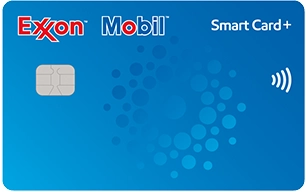
Exxon Mobil Smart Card+ Credit Card
Earn instant savings at the pump with every gallon of Synergy fuel purchased, plus 5% back on convenience store purchases. No annual fee.
Annual fee
None
Top rate
0.12x gas & ev charging
Quick look
Instant Gas Savings
Save up to 12¢ per gallon at the pump
2.6
out of 5
Rewards
Fees
Welcome bonus
Perks
Value
Overall score is a weighted average: Rewards 20% · Fees 20% · Welcome bonus 20% · Perks 20% · Value 20%.
Ideal for
Exxon Mobil loyalists who fill up weekly, pay their balance in full every month, and want to shave cents off their fuel costs without paying an annual fee.
The verdict
The Exxon Mobil Smart Card+ is a single-purpose card for a single purpose: shaving cents off every gallon you pump at Exxon. The 10-12¢ per gallon savings hits at the moment of purchase, no point redemption required. But that laser focus is also its ceiling. You can only use it at Exxon Mobil stations, you get no sign-up bonus, and the 33% APR means carrying even a small balance will erase months of savings. The 5% back on convenience store purchases softens the blow slightly, but it caps at $60 per year. This card is worth opening only if you're a loyal Exxon customer who fills up regularly and always pay the balance monthly—for everyone else, flexible fuel rewards from Chase or Discover make far more sense.
Pros
- Instant 10-12¢/gallon savings applied directly at the pump—no point tracking or redemption.
- Zero annual fee means no monthly cost to keep the account.
- Reports to all three credit bureaus, helpful for credit building.
- Accessible to applicants with fair credit (around 640+).
Cons
- Only works at Exxon Mobil stations—no utility outside the brand.
- 33% variable APR is roughly 8-9 percentage points above average; carrying a balance erases savings fast.
- No sign-up bonus or promotional APR period.
- 5% back on convenience store purchases is capped at $1,200 per year, limiting upside to $60/year.
Reward rates
| Category | Rate | Details |
|---|---|---|
| Gas & EV charging | 0.12x | Save 12¢/gal on Synergy Supreme+ Premium gasoline |
| Gas & EV charging | 0.1x | Save 10¢/gal on regular, mid-grade and diesel fuels |
| Everything else | 0.05x | 5% back on drinks, snacks, car washes and more (first $1,200 in non-fuel purchases per year) |
The card's earnings are structured as instant savings rather than point accumulation. At the pump, you save 12¢/gallon on Synergy Supreme+ premium or 10¢/gallon on regular, mid-grade, and diesel—applied directly as a statement credit. In-store, you earn 5% back on drinks, snacks, and car washes, though this is capped at $1,200 in eligible purchases per year, topping out at $60 annual back. Compared to the catalog, the fuel savings are specialized and narrow—the card ranks 43rd among gas rewards cards. For everyday spending outside Exxon, it offers no rewards at all.
Fees and APR
Does it pay for itself?
The no-annual-fee structure is genuinely useful for low-income or credit-building users. However, the 33% variable purchase APR is the real cost consideration. If you carry even a $500 balance, you're paying roughly $41 per month in interest—wiping out 4-5 months of fuel savings instantly. This card only makes financial sense for people who treat credit as a spending tool and pay their balance in full every month.
Similar cards
No annual fee like the Exxon card, but 5% cash back on one rotating category of your choice (including gas) with no cap—more flexibility for non-Exxon users.
Also no annual fee; earns 5% back on gas and restaurants, 1% on everything else—broader earning categories and a first-year cashback match (double your rewards).
Frequently asked questions
Can I use this card anywhere other than Exxon Mobil?
No. This is a co-branded proprietary card that only works at Exxon Mobil stations. If you try to use it elsewhere, it will decline. For everyday spending, you'd need a separate card or different rewards program.
How does the 12¢ per gallon savings work exactly?
When you swipe at the pump, the savings is applied instantly as a statement credit on your account. You don't accumulate points or transfer balances—the discount appears within a few days. The rate is 12¢/gallon for Synergy Supreme+ premium fuel and 10¢/gallon for regular, mid-grade, and diesel.
What happens if I carry a balance?
The 33% variable APR kicks in and compounds monthly. If you carry a $1,000 balance for a year, you'll pay roughly $330 in interest—offsetting 33+ months of fuel savings. This card is financially viable only if you pay the full balance monthly.
Is the 5% back on convenience store purchases worth it?
Only if you buy frequently at Exxon Mobil convenience stores. The cap of $1,200 per year ($60 max back) is low compared to other cards' categories. For comparison, Chase Freedom Flex offers 5% on rotating categories with a $1,500 quarterly cap—triple the annual ceiling.
Reviewed by YoungerFinance Editorial · Last updated August 10, 2026