Capital One
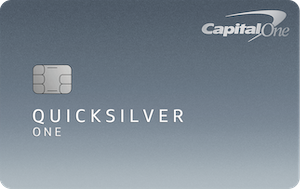
QuicksilverOne from Capital One
Unlimited 1.5% cash back on all purchases with automatic credit line reviews. Fair credit focused card with $39 annual fee.
Annual fee
$39
Top rate
1.5x everything else
Quick look
Unlimited 1.5% Cash Back
Earn rewards on every purchase, every day
2.8
out of 5
Rewards
Fees
Welcome bonus
Perks
Value
Overall score is a weighted average: Rewards 20% · Fees 20% · Welcome bonus 20% · Perks 20% · Value 20%.
Ideal for
Fair credit applicants who spend at least $2,600 annually and always pay their balance in full each month.
The verdict
QuicksilverOne targets a specific audience—people actively rebuilding credit who want cash rewards without the gatekeeping of premium cards. The flat 1.5% cash back on all purchases is modest but respectable for its tier, and the automatic credit line review every six months rewards good behavior. The real friction point is the $39 annual fee paired with a complete absence of a welcome bonus. You need to spend at least $2,600 yearly just to offset the fee, and the 28.99% APR means this card only makes sense if you're paying in full every month.
Compared to Capital One's own Quicksilver (which offers no annual fee plus a real welcome bonus), this feels like a compromise card. It's not bad—it does what it promises—but it's notably less generous than competing fair-credit options like the Bank of America Unlimited or TD Cash Secured.
Pros
- Unlimited 1.5% cash back on all purchases, with no category spinning required
- Accessible to fair credit, limited credit, or credit-building profiles
- Automatic credit line increase reviews every six months, no hard inquiry needed
- $0 foreign transaction fees for international purchases
Cons
- No welcome bonus—unlike the standard Quicksilver, you get no sign-up incentive
- $39 annual fee requires $2,600+ annual spend to break even
- 28.99% APR makes this unsuitable for carrying any balance
- No 0% intro APR on purchases or balance transfers
Reward rates
| Category | Rate | Details |
|---|---|---|
| Everything else | 1.5x | Unlimited 1.5% cash back on every purchase |
Unlimited 1.5% cash back is a flat rate across all categories. You rank 28th out of 142 cards in the catalog for cash back earning, which is middle-of-the-road. The 5% bonus rate on Capital One Travel bookings only applies if you book through Capital One's portal, which typically runs higher than competitive travel sites. Rewards never expire, so there's no time pressure to use them.
Fees and APR
Does it pay for itself?
The $39 annual fee is the core trade-off on this card. To make it worthwhile, you'd need to earn back that $39 in cash back, which means spending $2,600 per year (about $216/month). If you spend less than that, or if you carry a balance and get dinged by interest, this card works against you. Your main competitor in the same fee band, Capital One's SavorOne Rewards, targets dining instead but has the same structural problem.
Similar cards
Premium sibling with 0% annual fee, better rewards rate, and actual welcome bonus—but requires good credit instead of just fair.
No annual fee alternative offering 1.5% cash back plus a $250 bonus, but typically requires slightly higher credit than QuicksilverOne.
Frequently asked questions
Is the $39 annual fee worth it?
Only if you'll spend at least $2,600 this year and pay the full balance each month. At that spending level, you'll earn roughly $39 in cash back, making the fee neutral. Spend less, and you lose money. Carry a balance, and the high APR immediately overwhelms any rewards.
How does this compare to regular Quicksilver?
Quicksilver is Capital One's premium cash-back card with no annual fee, better rewards, and a sign-up bonus. QuicksilverOne is the fair-credit version. If you qualify for regular Quicksilver, choose that instead—it's strictly better.
Can I get a credit limit increase?
Yes, Capital One automatically reviews you for a credit line increase every six months with no hard inquiry. Many cardholders report seeing modest increases ($300–$500 at a time), which helps over time.
What if I can't pay off the balance?
Don't apply for this card if you plan to carry a balance. The 28.99% APR will quickly negate any cash back you earn. At that rate, a $1,000 balance costs $290/year in interest, erasing nearly seven years of cash back rewards on that same $1,000.
Reviewed by YoungerFinance Editorial · Last updated August 11, 2026