Chase
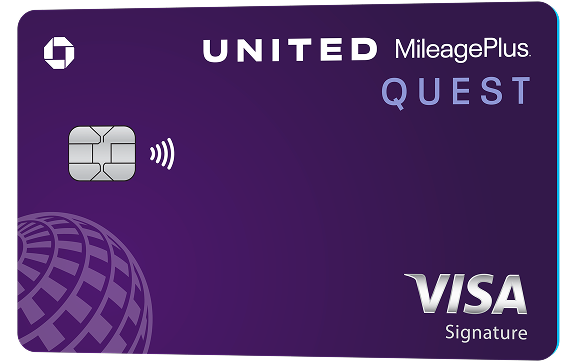
United Quest Card
Premium co-branded travel card offering 10x miles on United flights, $200 annual travel credit, free checked bags, priority boarding, and extensive travel protections.
Annual fee
$350
Top rate
10x flights
Welcome bonus
$700
Quick look
10x Miles on United Flights
Earn miles faster on your preferred airline
4.2
out of 5
Rewards
Fees
Welcome bonus
Perks
Value
Overall score is a weighted average: Rewards 20% · Fees 20% · Welcome bonus 20% · Perks 20% · Value 20%.
Ideal for
Semi-frequent United flyers who check bags regularly and can capture the $200 annual travel credit. The economics favor anyone booking 6+ United trips per year.
The verdict
The United Quest Card is built for one thing: United loyalists who fly regularly enough to justify a $350 annual fee. The math works if you check bags—two free checked bags plus a $200 annual travel credit reduce the effective cost to $150 before earning a mile. For moderate flyers hitting six or more trips per year with United, the combination of top-tier earning on flights (10x), status acceleration, and tangible credits delivers genuine value. For casual flyers or those who don't fly United, this card is a money-loser; the high annual fee and airline-locked miles offer nothing.
The Quest sits at an awkward premium tier. It outclasses the United Explorer (missing the second free checked bag and credit) but costs $200 more per year. For a frequent United traveler, it's the rational sweet spot. For everyone else, skip it.
Pros
- 10x miles on United flights—best-in-class earning for your primary airline
- $200 annual TravelBank credit effectively cuts the fee to $150 if used
- Free checked bags for you and a companion on every United trip
- Rapid status acceleration: up to 18,000 Premier Qualifying Points annually
- 25% back on inflight United purchases, capped but meaningful for regular flyers
Cons
- Miles are locked to United's MileagePlus program—no transferability to other airlines
- No airport lounge access included (unlike Capital One Venture X or premium Amex cards)
- Annual fee is brutal if you don't fly United regularly or don't use the $200 credit
- Dining, hotels, and other categories rank far behind specialized cards
Reward rates
| Category | Rate | Details |
|---|---|---|
| Flights | 10x | 10x total miles on eligible United flights |
| Hotels & car rentals | 5x | 5x miles on hotel stays when you prepay directly through Renowned Hotels and Resorts |
| Everything else | 4x | 4x miles on all other eligible United purchases |
| Hotels & car rentals | 2x | 2x miles on all other travel including airfare, trains, local transit, cruise lines, hotels, car rentals, taxicabs, resorts, ride share services and tolls |
| Dining & restaurants | 2x | 2x miles on dining including eligible delivery services |
| Streaming | 2x | 2x miles on select streaming services |
| Everything else | 1x | 1x mile on all other purchases |
The 10x on United flights is the highest rate in the catalog—no other card matches it. Where the Quest falters is everywhere else: 4x on United purchases ranks only second overall, 2x on dining lands you 32nd, and the 5x on Renowned Hotels (a locked partner) is narrow. This is a laser-focused card. If most of your travel spend happens on United and your occasional hotel stays go through Renowned, you'll extract exceptional value. If you split loyalty between airlines, the points isolation stings immediately.
Fees and APR
Does it pay for itself?
The $350 fee is defensible through concrete benefits: $200 TravelBank credit (use it or you've lost the deal), free checked bags (worth $30–60 per trip; 6 trips covers the fee for many travelers), priority boarding on United, 25% back on inflight purchases, and $10,000 annual award flight discounts. The question isn't whether the fee is justified in isolation—it isn't—but whether the package compounds into real savings for how you actually fly.
Welcome bonus
Is it worth chasing?
70,000 bonus miles plus 500 Premier Qualifying Points for $4,000 in 3 months. Using The Points Guy's standard April 2026 valuation, that's approximately $945 in travel value. The bonus is solid but not exceptional by premium card standards (the Delta Platinum hits 100,000 miles). The PQP acceleration toward elite status sweetens the deal for United loyalists planning status runs.
Similar cards
If you fly United but check bags fewer than 4 times per year, the $150 Explorer with its free bag and modest earning is significantly cheaper and covers most of the essentials.
Same $350 fee tier and 60,000-mile bonus, but locked to American Airlines instead of United. The comparison turns on which airline you fly most and which airline's credit (Delta, American, or United) matches your spend.
Frequently asked questions
Does the $200 annual credit really save me $200?
Only if you use it. The $200 TravelBank credit deposits automatically to your account annually, but it applies only to United-operated flights booked directly through United.com. If you never book direct United flights, the credit expires unused and the fee becomes a pure cost. Test how much you spend on direct United bookings before applying.
Can I transfer my miles to another airline?
No. United MileagePlus miles are locked to United and its partner airlines. If you value flexibility to shop redemptions across carriers, this card is a bad fit. A card like the Chase Sapphire Preferred lets you transfer points to 40+ travel partners; this gives you none of that freedom.
How do the free checked bags work?
You get two free checked bags (instead of the standard one) on United-operated flights for yourself and one companion on the same reservation. You and your traveling companion both save $30–40 per bag per segment. On a round-trip with checked luggage, that's $120–160 per person—nearly half the annual fee in one trip.
What's the credit score requirement?
Chase doesn't publish a minimum, but third-party reviews recommend a score of 700 or higher. As a premium card with a $350 fee, Chase targets established credit profiles. If your score is in the 660–700 range, you might be approved with a lower credit line; much below 660 and approval is unlikely.
Does this card come with United Club passes?
No. The United Club Infinite Card (higher tier, similar price) includes annual passes. The Quest gives you priority boarding (Group 2 for up to eight companions) and other perks, but not lounge access. If lounge access is essential to your travel comfort, you need the Infinite or a premium Amex.
Is the 70,000-mile welcome bonus worth the spend requirement?
You need $4,000 in spend within 3 months. If you can hit that through normal expenses or planned travel, the bonus is pure gain—approximately $945 in value. If you're manufactured spending or pushing spend you wouldn't otherwise make, the bonus becomes noise. Treat it as a bonus only if the timing naturally aligns.
Reviewed by YoungerFinance Editorial · Last updated August 11, 2026