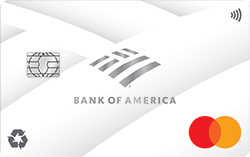
Bank of America
BankAmericard Credit Card
No-annual-fee credit card with 0% intro APR for 21 billing cycles on purchases and balance transfers made within 60 days of account opening.
Annual fee
None
Quick look
0% Intro APR
For 21 billing cycles on purchases and transfers
2.4
out of 5
Rewards
Fees
Welcome bonus
Perks
Value
Overall score is a weighted average: Rewards 20% · Fees 20% · Welcome bonus 20% · Perks 20% · Value 20%.
Ideal for
People with high-interest debt who need 18+ months to pay it down and have good-to-excellent credit.
The verdict
The BankAmericard is a single-purpose card with one strength: an uncommonly long 0% intro APR window spanning 21 billing cycles on both purchases and balance transfers (if transferred within 60 days). For someone sitting on high-interest debt and needing time to pay it down, that's genuinely valuable—21 months beats the industry average by several months.
But that's almost all the card offers. There are no rewards, no credits, and no premium perks. The 5% balance transfer fee is steep, the ongoing APR tops out at 25.99%, and customer reports flag aggressive fraud detection and inconsistent support. Skip this card if you carry a balance regularly or want to earn while you spend. Pick it only if you have existing high-interest debt, solid credit, and a plan to clear it within 21 months.
Pros
- 21-month 0% intro APR on purchases and balance transfers is longer than most competitors
- $0 annual fee makes the card genuinely free to hold
- No penalty APR, so late payments won't automatically trigger a rate increase
Cons
- 5% balance transfer fee is well above the industry average of 3.31%
- No rewards, cash back, or points—purely a debt-payoff tool
- 25.99% standard APR is high, so missed payments are expensive
Fees and APR
Does it pay for itself?
The $0 annual fee is a plus, but don't let that overshadow the card's limited use. It's free to hold, but unless you have a balance transfer in mind, there's no reason to apply.
Other benefits
- $0 Liability Guarantee for fraudulent transactions
- No penalty APR – late payments won't automatically raise your interest rate
- Balance Connect® overdraft protection service to help prevent declined purchases
- Digital Wallet Technology – add card to Apple Pay, Android Pay, or Samsung Pay
- Award-winning Online and Mobile Banking with account management
- Customizable account alerts for payments and balance notifications
- Access to credit education on budgeting and responsible credit use
- Paperless statement option to reduce paper consumption
Similar cards
Shorter intro period (18 months) but also 0% on transfers with a lower 3% fee
22-month 0% intro on purchases and 21 months on transfers, plus slightly lower APR after intro ends
Frequently asked questions
Is the 0% APR worth the 5% balance transfer fee?
It depends on your payoff timeline. If you can clear the balance in 21 months, the fee breaks even quickly because you're avoiding interest. If it takes longer, the high standard APR (up to 25.99%) means you'll pay far more in interest. Do the math: 5% fee upfront vs. months of interest charges. For large balances and aggressive payoff plans, usually yes. For small transfers or slow payoff, explore cards with lower transfer fees.
Can I use this for everyday purchases?
You can, but you shouldn't. The card offers zero rewards, so every purchase earns nothing—you're just getting a 0% intro rate. If you're buying on the card and paying interest after the intro period ends, the 25.99% APR is punishing. Use this card only for balance transfers or planned large purchases you'll pay off before the intro ends.
How does this compare to the BankAmericard for Students or Secured versions?
The standard BankAmericard, the student version, and the secured version all share the same 0% intro APR and annual fee. The key differences are eligibility (students/no credit history) and credit limit (secured requires a deposit). Benefit-wise, they're the same bare-bones package.
What credit score do I need?
Bank of America doesn't publish a minimum, but third-party reviews consistently report that approved applicants have excellent credit (typically 740+). If your score is below that range, approval is unlikely.
Reviewed by YoungerFinance Editorial · Last updated August 10, 2026