Chase
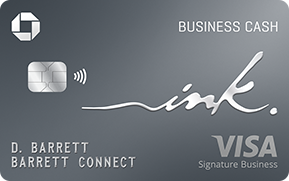
Chase Ink Business Cash Credit Card
Earn up to 5% cash back on business essentials with 0% intro APR for 12 months. No annual fee with $1,000 welcome bonus.
Annual fee
None
Top rate
0.05x online shopping
Welcome bonus
$1,000
Quick look
5% Cash Back on Business Essentials
Maximize rewards on everyday business purchases
3.6
out of 5
Rewards
Fees
Welcome bonus
Perks
Value
Overall score is a weighted average: Rewards 20% · Fees 20% · Welcome bonus 20% · Perks 20% · Value 20%.
Ideal for
Small business owners and sole proprietors with predictable spending on office supplies, internet services, and telecom—where the card's high category multipliers actually line up with your budget. Less useful for international businesses or those in growth mode.
The verdict
The Ink Business Cash is the no-fee business card that actually targets your business expenses, not just aspiration—if your spending aligns with its categories. Five percent on office supplies and telecom is genuinely useful, and the $1,000 welcome bonus is honest-to-god achievable without manufactured spending. The hitch: that $25,000 annual cap per category means a scaling business quickly outgrows it. You'll also contend with low initial credit limits (users report $3,000–$5,000 out of the gate) and the March 2026 restriction that kills external bank transfers for cash back.
It's a legitimate workhorse for small operators in specific verticals, but it's not a Swiss Army knife—it's a well-made Phillips head when you happen to need one.
Pros
- No annual fee with strong 5% rewards on office supplies and telecom (the categories most businesses actually spend in)
- Honest welcome bonus: $1,000 cash back is achievable in 4 months for most small businesses
- 12 months of 0% intro APR on purchases gives breathing room for cash flow
- Unlimited 1% cash back on everything else—no category restrictions on the base rate
Cons
- $25,000 annual spending cap per category is a real ceiling for any business scaling past year one
- Reported low initial credit limits ($3,000–$5,000) may force you to ask for increases immediately
- March 2026 rule change: cash back no longer transfers to external bank accounts—only Chase deposits, statement credits, or travel
- 3% foreign transaction fee makes international travel and purchases expensive for global businesses
Reward rates
| Category | Rate | Details |
|---|---|---|
| Online shopping | 0.05x | 5% cash back on office supply stores and internet, cable and phone services (up to $25,000 combined per year) |
| Dining & restaurants | 0.02x | 2% cash back on dining and gas stations (up to $25,000 combined per year) |
| Gas & EV charging | 0.02x | 2% cash back on dining and gas stations (up to $25,000 combined per year) |
| Everything else | 0.01x | 1% cash back on all other purchases with no limit |
The two-tier structure—5% and 2% in capped categories, 1% everywhere else—makes this card crystal-clear in its purpose: if you spend $25,000/year on office supplies, you're capping out at $1,250 in rewards, same as a flat 5%. The strength is focus: most no-fee cards scatter points across eight categories. This one bets on three. For office-heavy businesses, it's high value. For diversified spenders, you'll leave cash back on the table.
Fees and APR
Does it pay for itself?
Zero annual fee puts this alongside peers like the Ink Business Unlimited and Costco cards. Where it diverges: the Unlimited offers 1.5% flat on everything (simpler, less ceiling), while the Costco card ties you to membership. The Ink Cash wins if your spending is heavily office-skewed, loses if you need flexibility.
Welcome bonus
Is it worth chasing?
The $1,000 is competitive for a no-fee card. The $8,000 spend threshold is moderate—four months is typical for small business operations (office buys, telecom, inventory). The issue isn't hitting it; it's that the bonus doesn't offset the category caps long-term. First-year value is solid; year two depends entirely on your spending pattern matching the categories.
Similar cards
Same issuer. The Unlimited offers 1.5% flat on everything—simpler earning but a lower ceiling. Choose Unlimited if you value simplicity and spread spending; choose Cash if office/telecom is your heaviest category.
Also no fee, also rewards office and gas. Costco membership required. Similar category approach but rewards tier depends on membership status. Compare if you're already a member.
Frequently asked questions
How much cash back can I earn in a year?
Maximum $1,750 annually if you hit both category caps ($1,250 from 5% + $500 from 2%) plus additional 1% on unlimited spending. Many small businesses earn $800–$1,200 depending on their mix.
What changed in March 2026 that affected this card?
Chase blocked cash-back transfers to external bank accounts across Ink, Sapphire, and Freedom cards. You can still redeem as a statement credit, deposit to a Chase bank account, or book travel through Chase, but the flexibility to move rewards to a different bank is gone.
Is the $8,000 spending requirement realistic?
Yes—for most businesses that use the card operationally, $2,000 monthly spend over 4 months is achievable. If your business spends less than that, this card isn't urgent.
Why is the initial credit limit so low?
Chase is conservative with unsecured business cards for new applicants. Limits of $3,000–$5,000 are typical. Request an increase after a few months of on-time payments; you'll likely get more room.
Should I get this instead of Ink Business Unlimited?
If 80% of your spending is office supplies and telecom, yes—you'll earn 5% vs 1.5%. If your spending is scattered across categories, Unlimited's flat rate and simplicity are worth more.
Reviewed by YoungerFinance Editorial · Last updated August 11, 2026