Chase
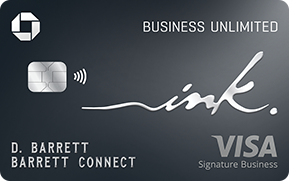
Ink Business Unlimited Credit Card
Unlimited 1.5% cash back on all purchases with no annual fee. New cardmembers earn $1,000 cash back bonus with $8,000 spend in first 4 months.
Annual fee
None
Top rate
1.5x everything else
Welcome bonus
$1,000
Quick look
Unlimited Cash Back
1.5% cash back on every purchase, no annual fee
3.9
out of 5
Rewards
Fees
Welcome bonus
Perks
Value
Overall score is a weighted average: Rewards 20% · Fees 20% · Welcome bonus 20% · Perks 20% · Value 20%.
Ideal for
Small business owners prioritizing simplicity and zero annual fees over category bonuses. Ideal for companies with domestic-only spending and predictable, broad-based costs.
The verdict
The Ink Business Unlimited delivers exactly what its name suggests: unlimited rewards with no strings attached. At $0 annually with a flat 1.5% cash back on every purchase, it's the right card for business owners who prize simplicity over category maximization. The 0% intro APR for 12 months and $1,000 welcome bonus add genuine short-term value—not just marketing.
But straightforward isn't exceptional. The 1.5% rate trails newer competitors like Wells Fargo Signify (2%) and Capital One Spark Cash (2%), and the 3% foreign transaction fee stings international spenders. For domestic-only, all-purpose spending with minimal complexity, it's a solid pick. For category-heavy businesses or global operations, you'll find better suited cards.
Pros
- Truly unlimited—no caps, no quarterly bonuses to track, 1.5% on every dollar spent
- Zero annual fee paired with $1,000 intro offer ($8,000 spend in 4 months) makes the first year clearly profitable
- 12-month 0% APR on purchases provides breathing room for major business purchases
Cons
- 1.5% cash back is now middle-of-pack; competitors have moved to 2% flat rates
- 3% foreign transaction fee eliminates value for internationally-focused businesses
- No bonus categories means cash back on office supplies, gas, or dining stays at 1.5%
Reward rates
| Category | Rate | Details |
|---|---|---|
| Everything else | 1.5x | Unlimited 1.5% cash back on every purchase |
1.5% unlimited on every purchase, everywhere, is the card's core appeal—and its main constraint. No bonus categories means high-spend areas like office supplies or utilities earn the same rate as everything else. That flatness is a feature (you don't have to think about it) and a bug (you're not optimizing for your spend pattern). Competitors like the Ink Business Cash offer 5% in categories if you're willing to track them; this card is for those who aren't.
Fees and APR
Does it pay for itself?
Zero dollars, which immediately separates this from premium business cards ($95–$550). That absence matters: you break even on the $1,000 welcome bonus at just $67,000 in spend. For most small businesses, that's achievable in the first year alone, making this card net-positive from day one.
Welcome bonus
Is it worth chasing?
The $1,000 bonus (after $8,000 spend in 4 months) is solid for a no-fee card but unremarkable against premium offerings. It's attainable without manufactured spending, which is the real value here—applicants should expect to spend $8,000 naturally.
Similar cards
Bonus categories (5% on gas, internet, phone, etc.) if you'll track spending; same issuer but more complex
Also unlimited 1.5% cash back with no annual fee, but consumer card (not business-specific) and no intro 0% APR
Frequently asked questions
Can I convert my 1.5% cash back into travel points?
Yes, but only if you also hold an eligible Chase Ultimate Rewards card (like Sapphire Preferred). The Unlimited card alone caps rewards as cash. If you're willing to hold a second card, you unlock the ability to transfer cash back into transferable points—a meaningful step up. Otherwise, cash back stays as cash.
What's the 3% foreign transaction fee going to cost me?
It compounds quickly for international businesses. On $100,000 of foreign spending, 3% is $3,000—more than the first-year $1,000 bonus wipes out. If your company books flights, pays vendors overseas, or has international revenue, compare this to Capital One Spark Cash (0% foreign fee) or Wells Fargo Signify (0% foreign fee) before applying.
Does the 0% intro APR apply to balance transfers?
No—the 0% APR only covers new purchases for the first 12 months. After that, the variable APR (currently 16.74%–24.74%, depending on creditworthiness) applies. This intro period is useful for timing large seasonal purchases, not for carrying balances from other cards.
Who qualifies for this card?
Chase requires an EIN (employer identification number) and business income documentation, though sole proprietors with a Social Security number can apply. The card reports to business credit bureaus if you have an EIN; personal credit is still a major factor. Expect a modest credit score threshold, likely around 670+, though Chase hasn't published exact minimums.
Reviewed by YoungerFinance Editorial · Last updated August 11, 2026