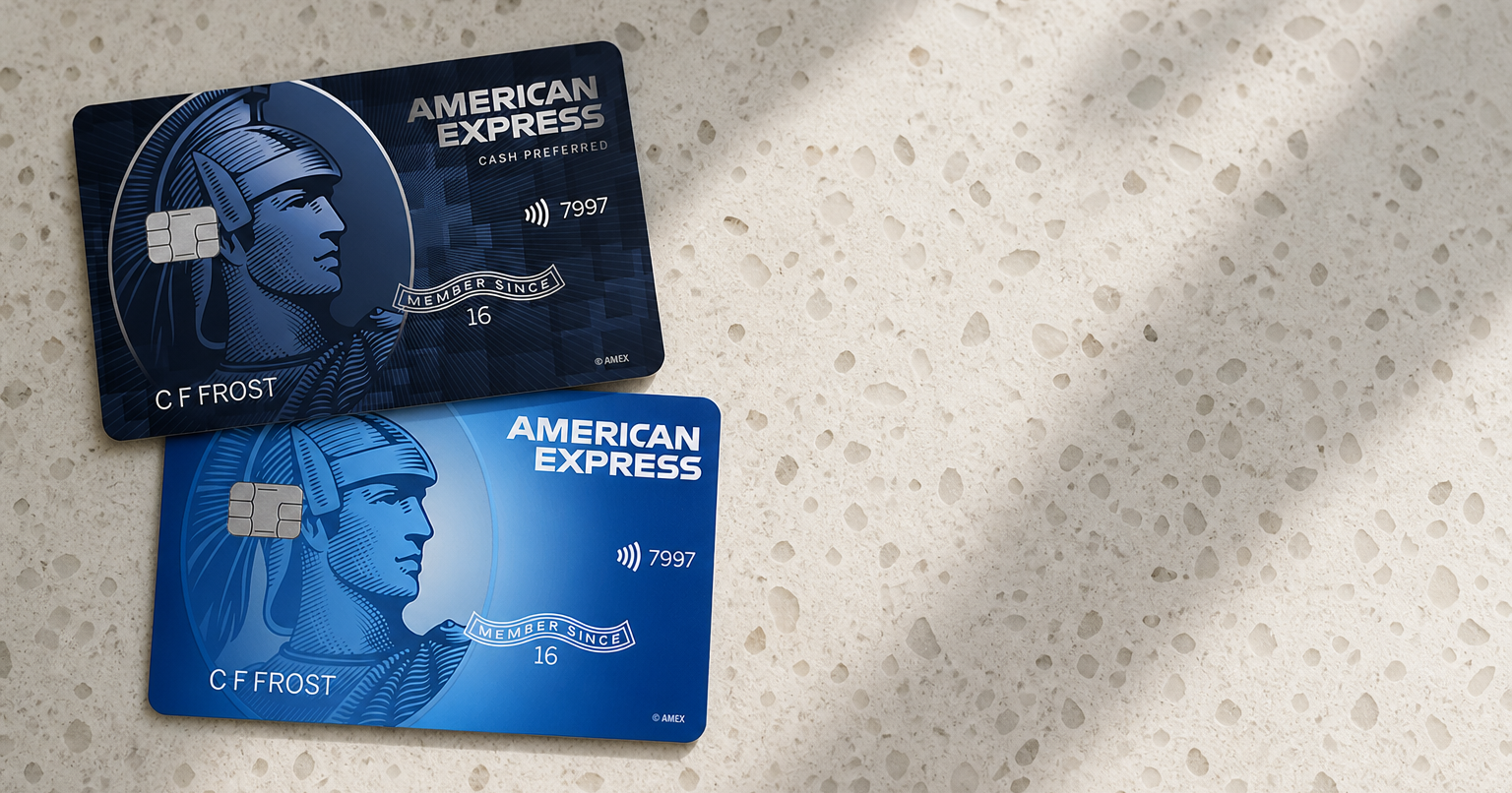
Six percent back on groceries is the highest grocery rate any mainstream credit card pays. That's the Amex Blue Cash Preferred, and it costs $95 a year after a free first year. Its sibling, the Blue Cash Everyday, pays 3% at the same supermarkets and charges nothing, ever.
So the blue cash preferred vs everyday question looks like a simple one: is the extra 3% worth $95? It mostly is — but only if your spending actually looks like Amex assumes it does, and there's a category where the free card straight-up beats the paid one.
What each card pays
Both cards cap their headline grocery rate at $6,000 of spending per calendar year, which works out to $500 a month. Past that you drop to 1%.
| Category | Blue Cash Preferred | Blue Cash Everyday |
|---|---|---|
| U.S. supermarkets | 6% (first $6,000/yr) | 3% (first $6,000/yr) |
| U.S. online retail | 1% | 3% (first $6,000/yr) |
| U.S. gas stations | 3% | 3% (first $6,000/yr) |
| Transit and rideshare | 3% | 1% |
| Select U.S. streaming | 6% | 3% |
| Everything else | 1% | 1% |
| Annual fee | $0 first year, then $95 | $0 |
Notice the second row. The Everyday pays 3% on U.S. online retail and the Preferred pays 1%. That's the piece most comparisons skip, and it's the reason the free card isn't simply a weaker version of the paid one. If a big chunk of your spending happens on the internet rather than in a supermarket aisle, the math flips.
Both cards also carry a Disney Bundle statement credit — roughly $10 a month on the Preferred and $7 a month on the Everyday — which only counts for anything if you already subscribe. The Preferred adds a monthly Equinox credit that almost nobody should factor in unless they're already a member.
The break-even, in one number
Strip out everything else and just look at groceries. The Preferred earns 3 percentage points more than the Everyday on up to $6,000 a year. To cover a $95 fee on that gap alone you need:
$95 ÷ 0.03 = $3,167 a year, or about $265 a month, at U.S. supermarkets.
Spend more than that on groceries and the Preferred is ahead before you count anything else. Max out the full $6,000 and the grocery category alone produces $360 against the Everyday's $180 — $180 more, or $85 net of the fee.
That's the whole break-even. Everything past this point is about whether your other categories widen the gap or close it.
Two households, two different answers
A family that cooks at home. Say $500 a month in groceries ($6,000 a year), $60 a month in streaming, $150 a month in gas, $200 a month online.
- Preferred: $360 groceries + $43 streaming + $54 gas + $24 online = $481, minus the $95 fee = $386
- Everyday: $180 groceries + $22 streaming + $54 gas + $72 online = $328
The Preferred wins by $58 a year, and that's a household that isn't even using the transit bonus.
A single person who orders everything. Say $200 a month in groceries, $30 in streaming, $80 in gas, $400 a month in online shopping.
- Preferred: $144 + $22 + $29 + $48 = $243, minus $95 = $148
- Everyday: $72 + $11 + $29 + $144 = $256
The Everyday wins by $108 — a bigger margin than the Preferred managed in the first example. Same two cards, opposite verdict, driven almost entirely by that online retail row.
If you want to be precise about which of your purchases land in which bucket, it's worth understanding how issuers actually categorize your spending, because the answer is frequently not what you'd assume.
The supermarket definition that ruins the math
Here's the gotcha that costs people more money than any other detail on these cards: "U.S. supermarkets" does not mean "places you buy groceries."
Amex excludes warehouse clubs and superstores from the category. That means Costco, Sam's Club, BJ's, Walmart, and Target all earn 1% — not 6%, not 3% — even when your entire cart is food. Specialty stores like a standalone butcher or a farmers market usually don't code as supermarkets either.
If you're a Costco-and-Walmart household, the Blue Cash Preferred's headline rate is close to fiction for you. Before you pay $95, pull up three months of statements and add up only what you spent at places like Kroger, Safeway, Publix, Albertsons, Whole Foods, or your regional chain. That number, not your total grocery spending, is what the 6% applies to.
Two smaller practicalities. Both cards pay out in Amex Reward Dollars, redeemed as a statement credit rather than deposited to a bank account. And Amex acceptance, while far better than it used to be, still lags Visa and Mastercard at small independent shops — which is exactly where some people do their food shopping.
Which one to get
Pick the Blue Cash Preferred if you spend more than roughly $265 a month at an actual supermarket, and especially if you also pay for several streaming services — the 6% streaming rate is the best available and stacks nicely on top of the grocery bonus. Just remember the fee is waived for year one, so you get twelve months to test whether your spending really supports it before Amex charges you anything.
Pick the Blue Cash Everyday if your grocery spending is modest, if you buy a lot online, or if you shop primarily at Walmart, Target, or a warehouse club. It's also the safer default for anyone who doesn't want to re-evaluate a fee every year.
One combination worth mentioning: because the Preferred's first year is free, some people open it, run a year of groceries through it, and then downgrade to the Everyday before the $95 posts if the numbers didn't work out. Amex generally allows that product change, and it keeps your account age intact rather than closing the card.
Whichever you land on, the streaming side of these cards is often the tiebreaker people forget to price in — and there are cards that pay more for streaming specifically if that's where your money actually goes.