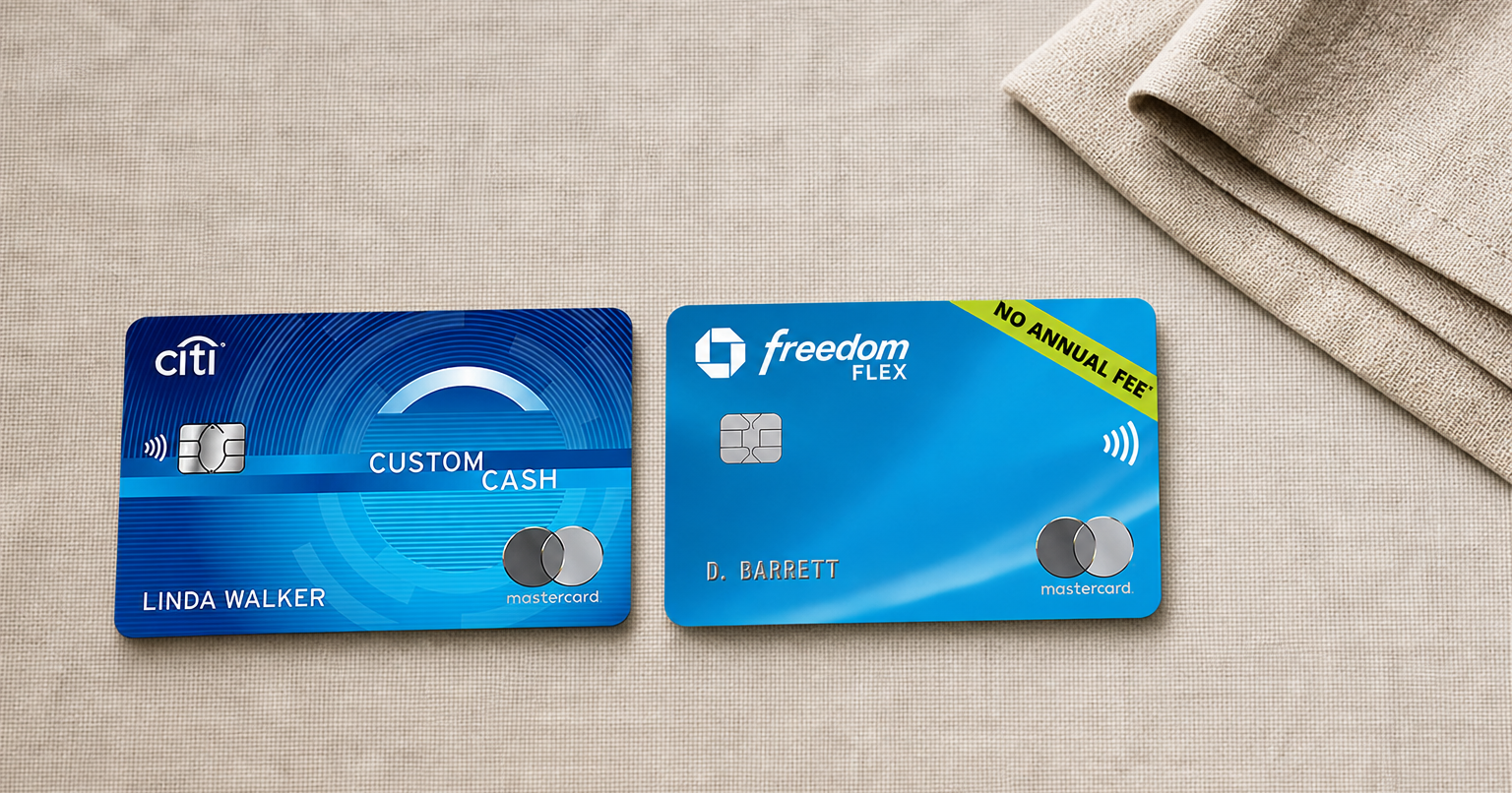
Run the numbers on Citi Custom Cash vs Chase Freedom Flex and you land on a strange coincidence. The Custom Cash pays 5% on your top spending category, capped at $500 per billing cycle — that's $25 a month, or $300 a year. The Freedom Flex pays 5% on rotating quarterly categories, capped at $1,500 per quarter — that's $75 a quarter, or $300 a year. Two completely different designs, same ceiling.
Which means the comparison isn't about how much 5% you can earn. It's about how hard you have to work to get it, and what else the card does when the 5% runs out.
One thing to know before you read any further: you can't apply for the Citi Custom Cash anymore. Citi stopped accepting new applications on May 28, 2026. Existing cardholders kept everything — same 5%, same $0 annual fee, same $500 cap — but the card is closed to newcomers, and the only remaining way in is a product change from another Citi card you already hold. If you don't have Citi plastic in your wallet today, the Freedom Flex is the only card in this comparison you can actually get.
That doesn't make the matchup pointless. The Custom Cash is still the benchmark every "top category" card gets measured against, everyone already holding one has to decide whether it's worth keeping, and the product-change door hasn't closed. Here's how the two actually compare.
The 5% caps are identical, but the effort isn't
The Custom Cash requires nothing from you. Each billing cycle, Citi looks at where you spent the most across ten eligible categories — restaurants, gas stations, grocery stores, select travel, select transit, select streaming, drugstores, home improvement, fitness clubs, and live entertainment — and pays 5% on the first $500 in whichever one won. No enrollment, no calendar, no decision. If your spending shifts from gas in the summer to groceries in the winter, the card follows you.
The Freedom Flex requires you to activate each quarter, and Chase picks the categories, not you. In Q3 2026 it was gas stations and EV charging, public transit, live entertainment, and United Way donations. In Q4 2026 it's grocery stores (Walmart and Target excluded), dining, and American Red Cross donations. Miss the activation and you earn 1% instead of 5% for three months — a $60 mistake that a surprising number of people make every year.
Here's what that difference looks like for someone spending $400 a month on groceries, which is a fairly ordinary number:
- Custom Cash: groceries win the category every month. $400 × 5% = $20/month, or $240 a year.
- Freedom Flex: groceries are a bonus category in Q4 only. $1,200 of Q4 grocery spend at 5% = $60, plus the other nine months at 1% = $36. Total: $96 a year.
For steady, predictable spending in one lane, the Custom Cash isn't close. It more than doubles the Flex on the same purchases, and you never touch a setting.
Flip the scenario, though. If you actually max the Flex calendar — $500 a month in whatever Chase has chosen, every quarter — you hit the full $300, the same as the Custom Cash's best case. And then the Flex keeps going.
What the Chase Freedom Flex earns after the 5% runs out
This is where the two cards separate, and it's the part most head-to-head write-ups skip.
The Custom Cash pays 1% on everything that isn't your top category. That's it. Dining, gas, your phone bill, the dentist — all 1%, all year, unless that category happens to be your biggest one that cycle. The card has exactly one good rate and nine categories it will happily ignore.
The Freedom Flex has a floor underneath the rotating categories: 3% on dining including takeout and delivery, 3% at drugstores, and 5% on travel booked through Chase Travel. None of those are capped. If you spend $250 a month eating out, that's $3,000 a year at 3% — $90 in the bag before the quarterly calendar does anything. On the Custom Cash, that same $3,000 earns $30 in any month groceries or gas outranked it.
Stack it up and the shape becomes clear. The Custom Cash has the higher floor: it will reliably produce $200–$300 a year from someone who does nothing but swipe it. The Flex has the higher ceiling: between the rotating $300 and uncapped 3% categories, an engaged user can clear $450–$500 without unusual spending. The Flex also comes with a $200 bonus after $500 in purchases in the first three months, and cell phone protection when you pay your phone bill with the card — a perk the Custom Cash doesn't offer.
Neither card charges an annual fee, and both charge a 3% foreign transaction fee, so neither belongs on an international trip. If you're weighing the Flex against its sibling rather than against Citi, we've already broken that down in Chase Freedom Unlimited vs Flex — the short version is that the Unlimited's flat 1.5% often beats the Flex for people who won't manage a calendar.
What the Citi Custom Cash closing means for you
Citi didn't announce the shutdown loudly — it surfaced through internal guidance sent to branch staff — and the bank now steers would-be applicants toward the Citi Double Cash instead. Nothing was taken away from people who already have the card, which is unusual; when issuers retire a product they often gut it first. Citi just stopped letting new people in.
So the practical question isn't "which should I apply for." It's one of these three:
You already have the Custom Cash. Keep it. A no-annual-fee card paying an automatic 5% on your top category is worth holding indefinitely, and closing it would shorten your average account age for no reason. Pair it with something that covers everything else — the Double Cash's flat 2%, or the Freedom Flex for its 3% dining.
You have another Citi card. Product changes into the Custom Cash were still going through after the application window closed, including from the Double Cash and Citi Rewards+. It's worth a phone call, though Citi hasn't said how long that stays open. One caution: converting your Double Cash means giving up a flat 2% on everything to get 5% on $500 a month. If your total spending is high and concentrated outside the eligible categories, that trade can lose you money. A spare Citi card you barely use is the better candidate.
You have neither. Then the Freedom Flex is the card actually on the table, and the Custom Cash is a benchmark you can't buy. Worth knowing before you apply: the Flex is subject to Chase's 5/24 rule, meaning Chase will generally decline you if you've opened five or more personal credit cards across all issuers in the past 24 months. We cover what counts and what doesn't in the Chase 5/24 rule, and it's worth checking before you burn an application.
Which one actually belongs in your wallet
If you can still get the Custom Cash through a product change and your spending is lopsided — one category that dominates month after month — take it. Automatic 5% with zero maintenance is rare, and the card's whole value is that it works when you forget it exists.
If you're applying fresh, the Freedom Flex is the stronger card on paper anyway, provided you'll actually activate. Set a recurring calendar reminder for January 1, April 1, July 1, and October 1. That single habit is the difference between a card worth $450 a year and a card worth $150.
And if you know you won't manage a calendar — be honest about that — neither of these is your card. A flat 2% on everything, with nothing to activate and no cap to track, will beat a mismanaged 5% card almost every time. The best rewards card is the one whose rules match how much attention you're willing to give it.