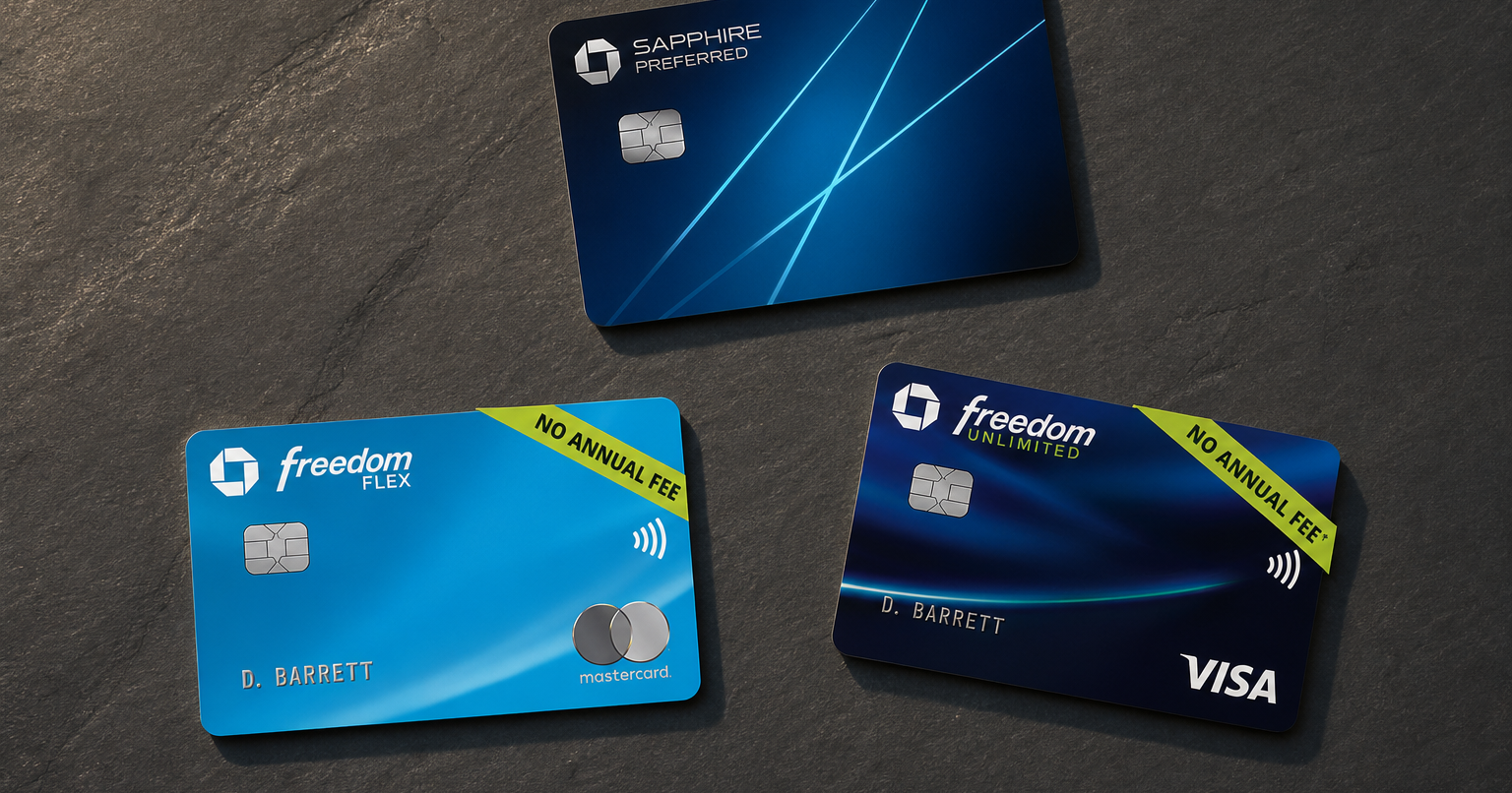
The Chase trifecta is the most recommended credit card setup on the internet: one Sapphire card plus the two no-annual-fee Freedom cards, all feeding a single pile of Ultimate Rewards points. For years the pitch was simple — the Freedoms earn the points, the Sapphire makes them worth more.
That second half stopped being true in 2026. Chase removed the fixed redemption bonus that made the whole thing click, then rebuilt the Sapphire Preferred in June with new categories that overlap what the Freedom cards already did. The trifecta still works. It just works for different reasons now, and it's worth understanding those before you open three credit cards.
What the three cards actually earn
All three cards earn the same currency, so the only question is which card touches which purchase.
Chase Sapphire Preferred — $95 annual fee. 5% on travel booked through Chase Travel, 3% on dining, 3% on gas and EV charging, 3% on streaming, 3% on online groceries (Walmart, Target, and wholesale clubs excluded), 2% on other travel, 1% on everything else. Current offer: 75,000 points after $5,000 in three months.
Chase Freedom Flex — $0 annual fee. 5% on rotating quarterly categories, capped at $1,500 per quarter and requiring activation each quarter. Plus 3% dining, 3% drugstores, 5% Chase Travel, 1% everything else.
Chase Freedom Unlimited — $0 annual fee. 1.5% on everything, with 3% dining, 3% drugstores, and 5% Chase Travel.
Notice how much of that is duplicated. Dining is 3% on all three cards. Chase Travel is 5% on all three. And the Preferred's June refresh added gas, streaming, and online groceries at 3% — categories the Freedom Flex used to cover through its rotating calendar. In 2023 each card had a clear job. In 2026 the Preferred does most of them on its own.
The redemption bonus is gone
This is the change that gets glossed over in most trifecta guides, and it's the important one.
The old mechanic: Freedom cards earn points worth 1 cent each on their own. Move those points to a Sapphire and every point became worth more when you booked through Chase's travel portal — 1.25 cents on the Preferred, 1.5 cents on the Reserve, guaranteed. That fixed multiplier was the entire argument for paying $95 to hold a Sapphire alongside two free cards. It turned a 5% Freedom category into an effective 6.25%.
Chase replaced it with Points Boost. Now points are worth a flat 1 cent on standard Chase Travel bookings regardless of which card you hold. Selected flights and hotels carry a promotional rate — up to 1.5 cents for Preferred holders, up to 2 cents for Reserve holders — but the selection rotates and you have to find a booking that qualifies. The guarantee became a sale rack.
The other reason to hold a Sapphire still stands: transfer partners. Freedom points can't move to airline and hotel programs on their own. Pooled into a Sapphire, they can. That's real, and for people who actually book award travel it's the main draw. But Chase trimmed there too — Hyatt transfers now run 4:3 for Sapphire Preferred holders, meaning 1,000 Chase points become 750 Hyatt points, and the 10% anniversary points bonus was eliminated outright.
So the honest 2026 framing is this: the trifecta is no longer a multiplier play. It's an earn-rate play with a travel-transfer option attached.
What the trifecta is actually worth
Run it on a realistic year. Say $4,800 on dining, $6,000 on groceries, $2,400 on gas, $600 on streaming, $3,000 on travel, and $9,000 on everything else — about $25,800 total.
With the full trifecta, you'd route dining, gas, streaming, and travel to the Preferred, groceries to the Freedom Flex when it's a rotating category and the Unlimited the rest of the year, and everything else to the Unlimited. That comes to roughly $570 a year, an effective rate of about 2.2%.
Now carry just the Freedom Unlimited by itself — one free card, nothing to manage. Dining at 3%, everything else at 1.5%. That's about $460 a year, or 1.78%.
The trifecta earns about $110 more. The Preferred costs $95. On earning alone, three cards and a quarterly activation reminder buy you about fifteen dollars.
What makes the Preferred worth holding isn't the earn rate — it's the credits. The card now carries a $100 annual Chase Travel hotel credit, a Global Entry or TSA PreCheck credit worth up to $120 every four years, a year of Apple TV, twelve months of DashPass, and no foreign transaction fees. Use the hotel credit alone and the $95 fee is already covered. Add the transfer partners and the trip protections and it's a clearly positive card to hold.
But that's an argument for the Sapphire Preferred. It is not, by itself, an argument for three cards.
Should you build the whole thing
Take these in order, because Chase makes the order matter.
Start with one free Freedom card. If you won't manage a quarterly calendar, take the Unlimited and its flat 1.5%. If you will, the Flex's rotating 5% is worth up to $300 a year. We've compared them directly in Chase Freedom Unlimited vs Flex, and the deciding factor really is whether you'll press the activation button four times a year.
Add the Sapphire Preferred if you travel. At $95 with a $100 hotel credit, it's close to free, and the 75,000-point welcome offer is the single largest chunk of value in the entire setup. If you're weighing it against the $795 Reserve, read Sapphire Preferred vs Reserve first — the Reserve's math only works if you'll actually use lounges and burn through several hundred dollars in narrow statement credits every year.
Add the second Freedom last, or not at all. This is the piece most guides insist on and most people don't need. With the Preferred now covering gas, streaming, and online groceries at 3%, the marginal card adds a slice of 5% rotating spend or a 1.5% floor — maybe $100 a year, in exchange for another account and another thing to think about.
The constraint that trips people up is Chase's 5/24 rule: if you've opened five or more personal credit cards from any issuer in the past 24 months, Chase will generally decline you regardless of your credit score. Since the Sapphire Preferred carries the biggest welcome bonus of the three, apply for it while you're still under the limit rather than burning slots on the free cards first. Our breakdown of what counts toward 5/24 covers the exceptions, including which business cards don't count.
The version most people should build
If you want the short answer: get the Sapphire Preferred and one Freedom card. That's a duo, not a trifecta, and it captures nearly all of the value — the welcome bonus, the credits that cover the fee, transfer access for your points, and a solid everyday earn rate — without the third account.
Build the full trifecta when your spending is high enough and varied enough that the third card's categories actually catch meaningful money, and when you genuinely enjoy optimizing. That's a real group of people. It's just a much smaller group than the number of articles recommending this setup would suggest.
The setup that beats every other one is the setup you'll still be using in three years. Two cards you understand will out-earn three cards you half-manage, every single time.