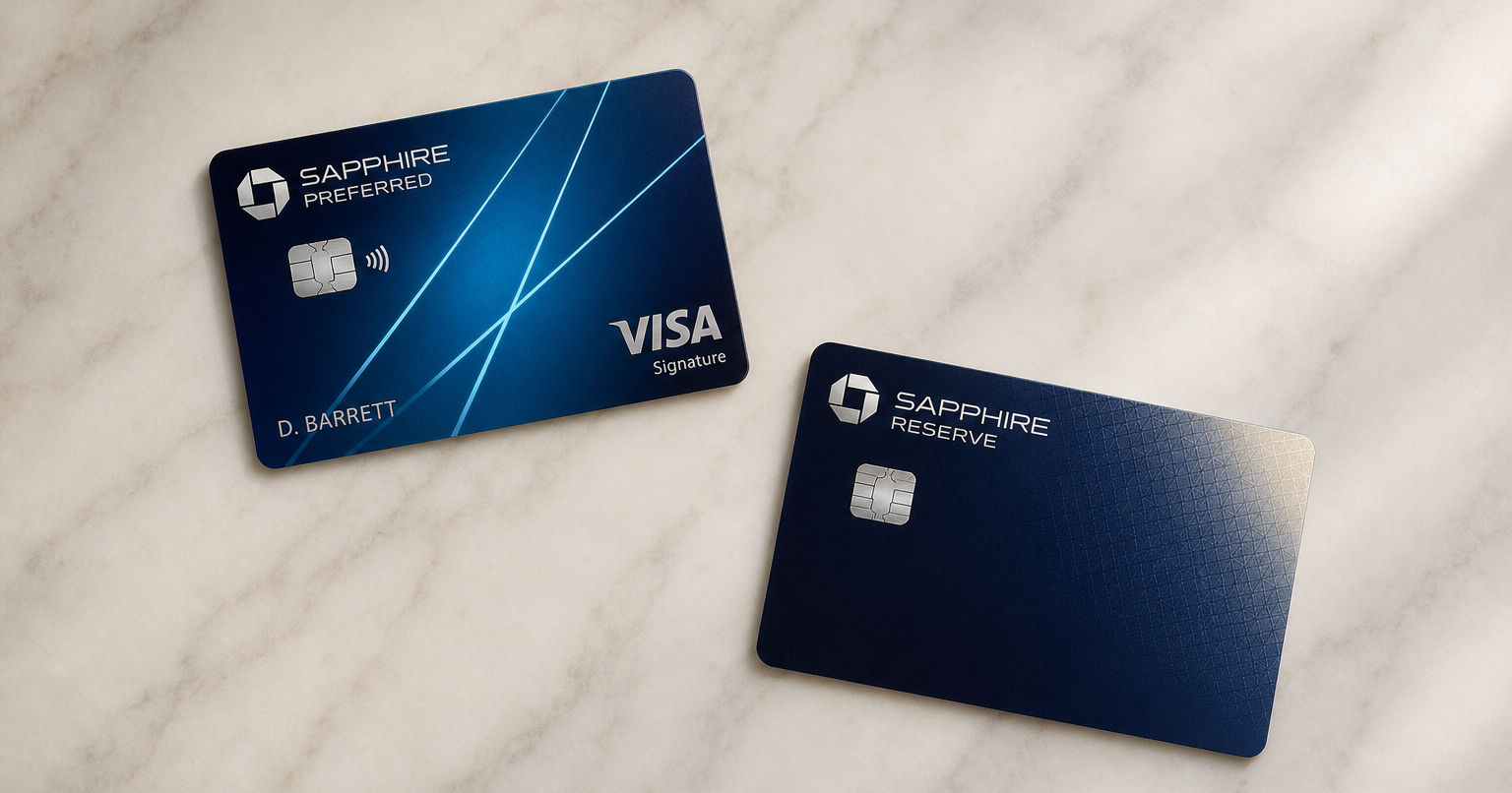
Chase and Lyft renewed their partnership on April 1, 2025, and the new terms run through September 30, 2027. If you were carrying a Sapphire Reserve before that date, you took a real cut. Lyft rides used to earn 10x points on the Reserve, and the card came with a free Lyft Pink All Access membership. Both are gone. What replaced them is 5x points and a $10 monthly in-app ride credit — up to $120 a year — and only Reserve holders get the credit at all.
So the Chase Sapphire Lyft benefits now come down to two things: a points multiplier both cards share, and a credit only one card has. Here's exactly what each is worth, and where the fine print quietly takes some of it back.
Both Sapphire Cards Earn 5x Points on Lyft Rides
This is the part people get wrong. The Chase Sapphire Preferred ($95 annual fee) and the Chase Sapphire Reserve ($795 annual fee) both earn 5x total points on Lyft through 9/30/2027. Not 5x on one and something better on the other — the same 5x.
What differs is how much of that 5x is new. Lyft codes as travel, so the Preferred would already earn 2x on rides; the promotion adds 3 points per dollar. The Reserve only earns 1x on rideshare, since its bonus categories are Chase Travel, direct-booked flights and hotels, and dining. So the promotion adds 4 points per dollar there. Different starting points, same destination.
The 5x covers rideshare, bike and scooter rides, and Lyft subscription and membership products. It excludes gift cards, car rentals, vehicle service centers, and miscellaneous fees. There's no spending cap.
Every figure below values Ultimate Rewards points at 1 cent each. That's Chase Travel's baseline rate — what you get booking whatever's convenient. Chase's Points Boost program can push select premium flights and hotels past 2 cents, but it depends on specific inventory being available when you want to travel, so it's upside rather than something to plan around. At 1 cent, 5x on Lyft is simply 5% back.
A normal commute, priced out. Four Lyft rides a month at $18 each comes to $864 a year. At 5x, that's 4,320 Ultimate Rewards points — about $43 back.
Scale that up and down and the shape of the benefit gets clearer:
| Annual Lyft spend | Points at 5x | Preferred value | Reserve value |
|---|---|---|---|
| $500 | 2,500 | $25 | $145 |
| $864 | 4,320 | $43 | $163 |
| $1,500 | 7,500 | $75 | $195 |
| $2,400 | 12,000 | $120 | $240 |
The Reserve column adds the $120 credit on top of the points, and it assumes you actually claim the credit all twelve months. That assumption is doing a lot of work, which brings us to the credit itself.
The $10 Monthly Lyft Credit Only Comes With the Reserve
The Reserve — plus the Sapphire Reserve for Business and the invite-only J.P. Morgan Reserve — gets up to $10 in Lyft credit each month through September 2027. That's a maximum of $120 a year, and it is the single benefit that separates the two Sapphire cards on Lyft. Notice from the table above that at low spend the credit is worth several times the points.
Four things about it trip people up.
It's an in-app discount, not a statement credit. The $10 comes off the ride subtotal at checkout inside the Lyft app. Nothing shows up on your Chase statement later. If you don't see it applied before you confirm the ride, you didn't get it.
It doesn't roll over. Unused credit expires at the end of every calendar month. Skip Lyft in February and that $10 is gone — there's no $20 waiting for you in March. You have to use it twelve separate times to collect the full $120. Miss four months and you're at $80.
Wait & Save rides don't qualify. Lyft's cheapest option, where you accept a longer wait for a lower fare, is excluded. So is any bike or scooter ride — even though those do earn the 5x. The credit only applies to Standard, Extra Comfort, XL, Black, and Black SUV. If your default move is Wait & Save at $9, you have to deliberately book a pricier Standard ride to use the credit, which partly defeats the point.
It applies to the subtotal only. Fees, taxes, and tips are excluded, and unused value within a single ride is forfeited. A $7 Standard ride pulls $7 from your $10 — the remaining $3 doesn't follow you to the next trip. A typical Standard Lyft ride runs $11 to $18 for about five miles in most US markets, so realistically the credit covers 55% to 90% of one ride a month.
There's a clean way to test whether the 2025 change helped or hurt you personally:
The $2,400 break-even. The Reserve gave up 5 points per dollar on Lyft — 5 cents of value per dollar at a penny a point. Divide the $120 credit by 5 cents and you land on $2,400 of annual Lyft spend, or $200 a month. Spend more than that and the old 10x deal was better for you. Spend less and the flat $120 wins.
Very few people spend $200 a month on rideshare, which is presumably why Chase structured it this way. The change was a downgrade aimed at heavy riders and a modest upgrade for everyone else.
Don't Put Lyft on the Wrong Chase Card
If you carry more than one Chase card, it's worth knowing that Chase gives every card in the lineup some Lyft benefit, and they are not equal:
| Chase card | Lyft benefit | Runs through |
|---|---|---|
| Sapphire Reserve, Reserve for Business, J.P. Morgan Reserve | 5x points + $10/month credit | 9/30/2027 |
| Sapphire Preferred | 5x points | 9/30/2027 |
| Ink Business Preferred, Ink Plus | 5x points | 9/30/2027 |
| Ink Business Unlimited, Cash, Premier | 5% cash back | 9/30/2027 |
| Freedom, Flex, Unlimited, Rise, Student | 2% cash back | 9/30/2027 |
| Southwest Rapid Rewards cards | 2x to 5x depending on card | 12/31/2027 |
A Freedom Unlimited earns 2% on Lyft. A Sapphire earns 5x, which at a penny a point is 5%. On $864 of annual rides that gap is about $26 a year — not life-changing, but it costs you nothing except changing which card is on file, and the same logic applies across every category you spend in. That's the kind of pairing decision we cover in how to build a two-card wallet.
None of it applies automatically, either. Open the Lyft app, tap the You tab, then Payment, and add your Chase card. For the 5x points, the card just has to be the one paying for the ride. For the $10 monthly credit, your Reserve needs to be set as the default payment method on the account.
What Else the Sapphire Cards Give You Beyond Lyft
Lyft is one line item on both cards, so it's worth seeing where it sits in the larger package before you pick between them.
| Sapphire Preferred | Sapphire Reserve | |
|---|---|---|
| Annual fee | $95 | $795, plus $195 per authorized user |
| Welcome bonus | 75,000 points after $5,000 in 3 months | 100,000 points after $6,000 in 3 months |
| Travel earning | 5x Chase Travel, 2x all other travel | 8x Chase Travel, 4x direct-booked flights and hotels |
| Dining | 3x | 3x |
| Other bonus categories | 3x gas and EV charging, streaming, online grocery | — |
| Annual credits | $100 Chase Travel hotel credit, $120 Global Entry every 4 years | $300 travel, $300 dining, $300 DoorDash value, $288 Apple subscriptions |
| Subscriptions included | 12 months Apple TV, 12 months DashPass | — |
| Lyft credit | none | $120 |
Stack those up and the point is obvious: the $120 Lyft credit is roughly 17% of the $700 fee gap between the two cards. It is not a reason to choose the Reserve. It's a nice-to-have on a card you're already justifying with the travel credit, the dining credit, and the lounges. If you want that comparison run properly, we did the full break-even in Chase Sapphire Preferred vs Reserve.
So: if you're a Reserve holder, set a recurring calendar reminder around the 25th of each month. The most common way people lose this benefit isn't the exclusions — it's forgetting that a credit with no rollover is use-it-or-lose-it twelve times a year, and at low ride volumes that $120 is worth more than all your Lyft points combined. If you're a Preferred holder, there's nothing to remember. Put the card on file in the Lyft app and let the 5x accumulate. And if you're still choosing between the two, decide on the travel and dining credits, then take the Lyft perk as whatever it turns out to be.