
There is a widely held assumption about credit cards that the data does not support: that they form a ladder. Free cards at the bottom, a better version for $95, a better one again for $550, each rung paying a little more than the last for the same wallet.
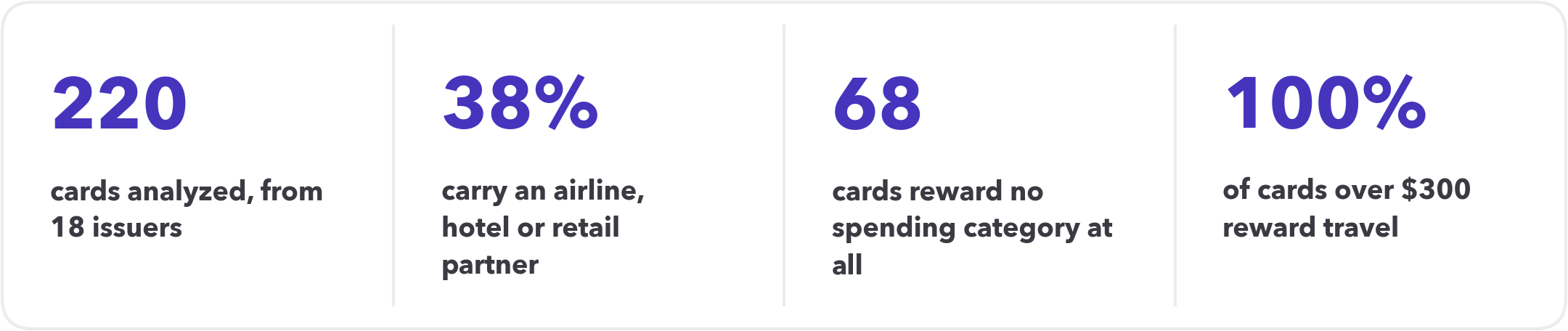
We went through all 220 active cards in our catalog, from 18 issuers, and sorted them by what they charge and what they reward. The tiers are not rungs. They are different products, sold to different people, that happen to share a name and a payment network. The clearest evidence is what happens to groceries.
The market has split in two
Start with price, because the shape is unusual.
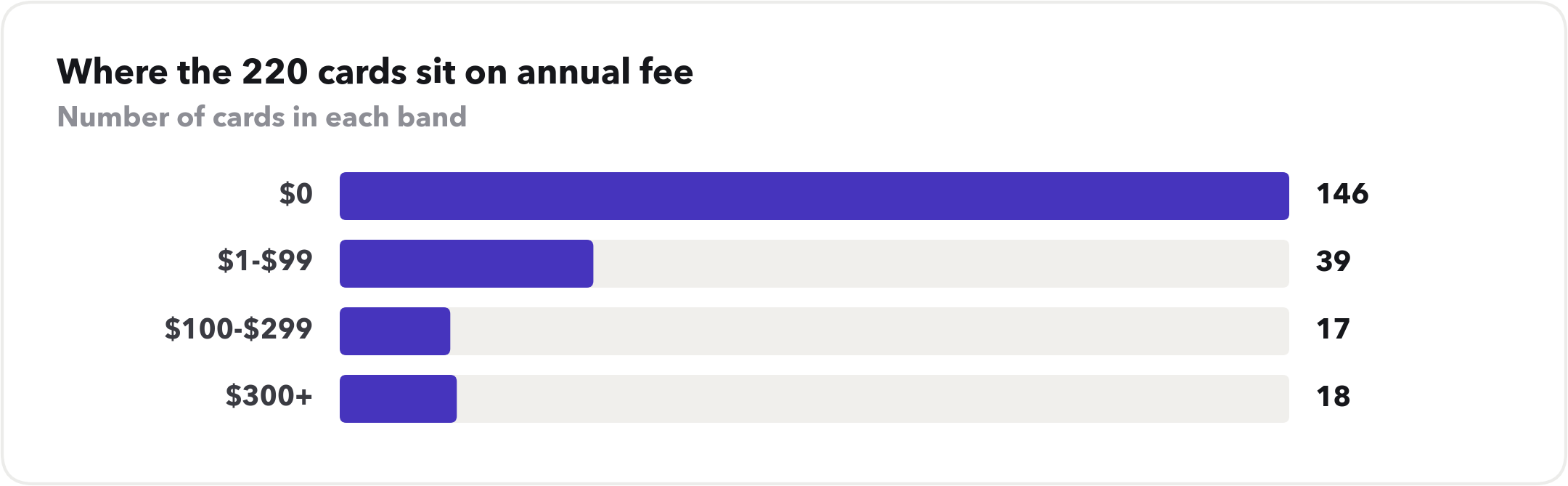
Two-thirds of the catalog costs nothing to hold. Another 8% costs $300 or more a year, running up to the $895 Platinum Card from American Express and a pair of $795 Chase Sapphire Reserve products. Between those poles, across the entire $100-to-$299 range, sit seventeen cards.
The pricing inside the paid tier is just as revealing. Of the 74 cards that charge anything, seventeen charge exactly $95 and ten charge exactly $99 — more than a third of all paid cards sitting on two price points four dollars apart. Nobody arrived at $95 by costing out the benefits. They arrived at it by looking at the competition.
Issuers have picked sides. Capital One offers 25 cards and 84% of them are free. Citi is at 76%, Bank of America at 73%. Chase, with the largest catalog at 41 cards, is at 34%, and its median card costs $95. American Express sits at the far end: 21% free, median fee $200. These are not variations on a strategy. They are different businesses.
Who is left in the middle
Thirty-eight percent of the catalog is co-branded — issued with an airline, a hotel group or a retailer attached. Most of those are cheap: 45 of the 84 charge no annual fee at all. But the concentration shifts with price, and it is highest exactly where the catalog is thinnest.
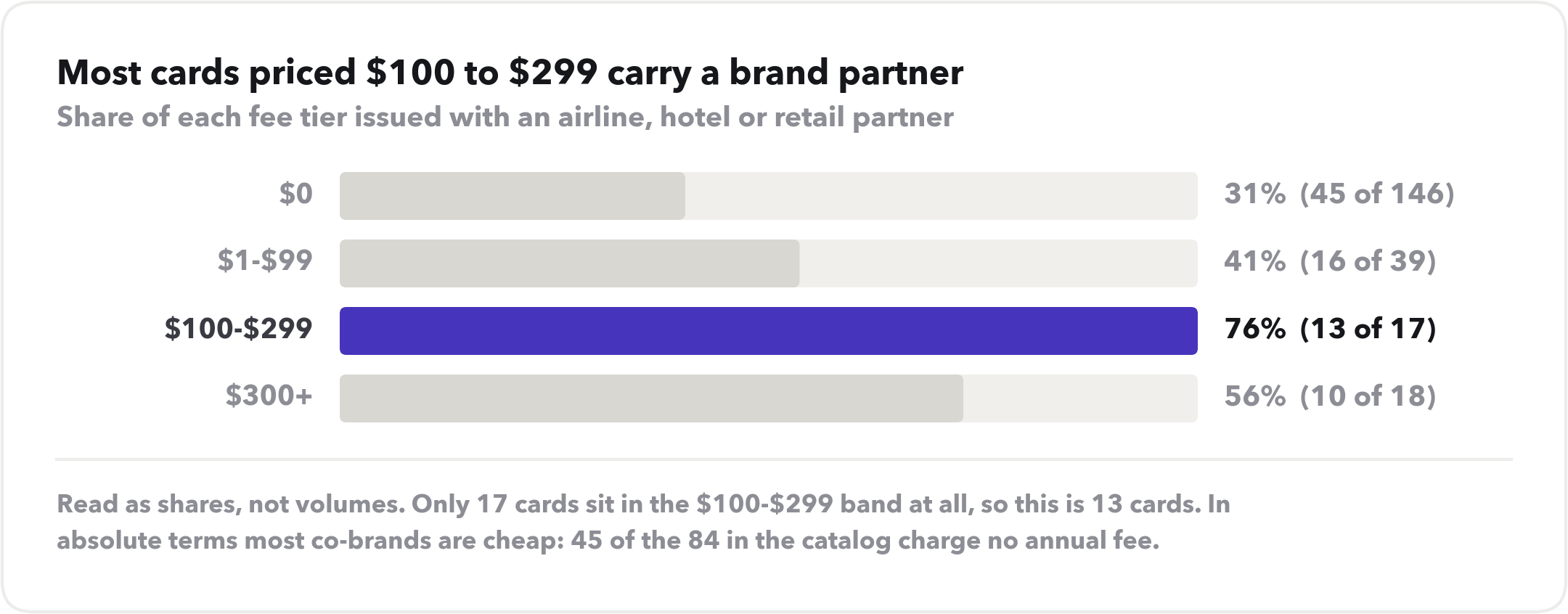
Thirteen of the seventeen cards priced between $100 and $299 carry a partner. The list reads like a departures board: four Southwest cards, two United, two Marriott, plus Delta, Hilton, Hyatt, Wyndham and Disney. The four that do not are the American Express Green Card, Chase's Ink Business Premier, TD Clear, and the Citizens Summit Reserve.
Seventeen cards is a thin base, and it should not be inflated into a law about the market. But it does describe what a shopper actually meets at that price. Someone willing to spend $150 a year on a general-purpose card has four options in this catalog. Everything else at that price is asking a different question — not how do you spend, but who do you fly.
What you are actually buying
Here is the finding that reframes the rest. As the price of a card goes up, it does not reward more. It rewards differently.
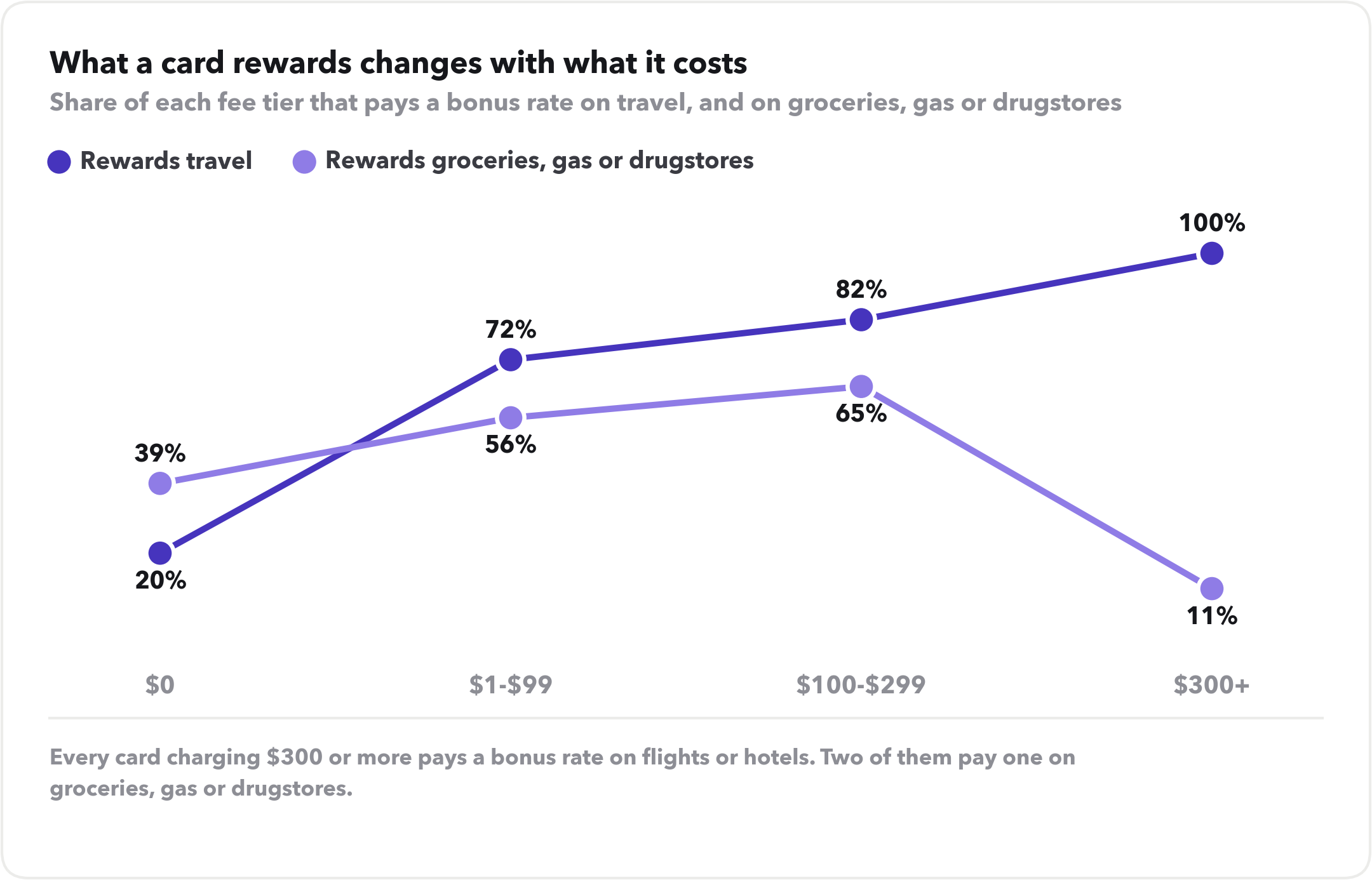
At $0, a card is twice as likely to reward groceries, gas or drugstores as it is to reward travel. By $300, that has inverted completely and then some: every single card charging $300 or more pays a bonus rate on flights or hotels, and just two of the eighteen pay one on groceries, gas or drugstores. Grocery coverage specifically runs 29%, 38%, 41% — and then falls off a cliff to 11%.
The premium tier is not a better cash-back card. It is not really a cash-back card at all. It is a travel product, and the further up the price curve you go, the more completely it assumes that the money you care about is the money you spend away from home.
That is a perfectly coherent thing for an issuer to build. It is only a problem if you bought one expecting the ladder.
Two categories, and then nothing
The second thing the data undercuts is the impression that bonus categories are everywhere.
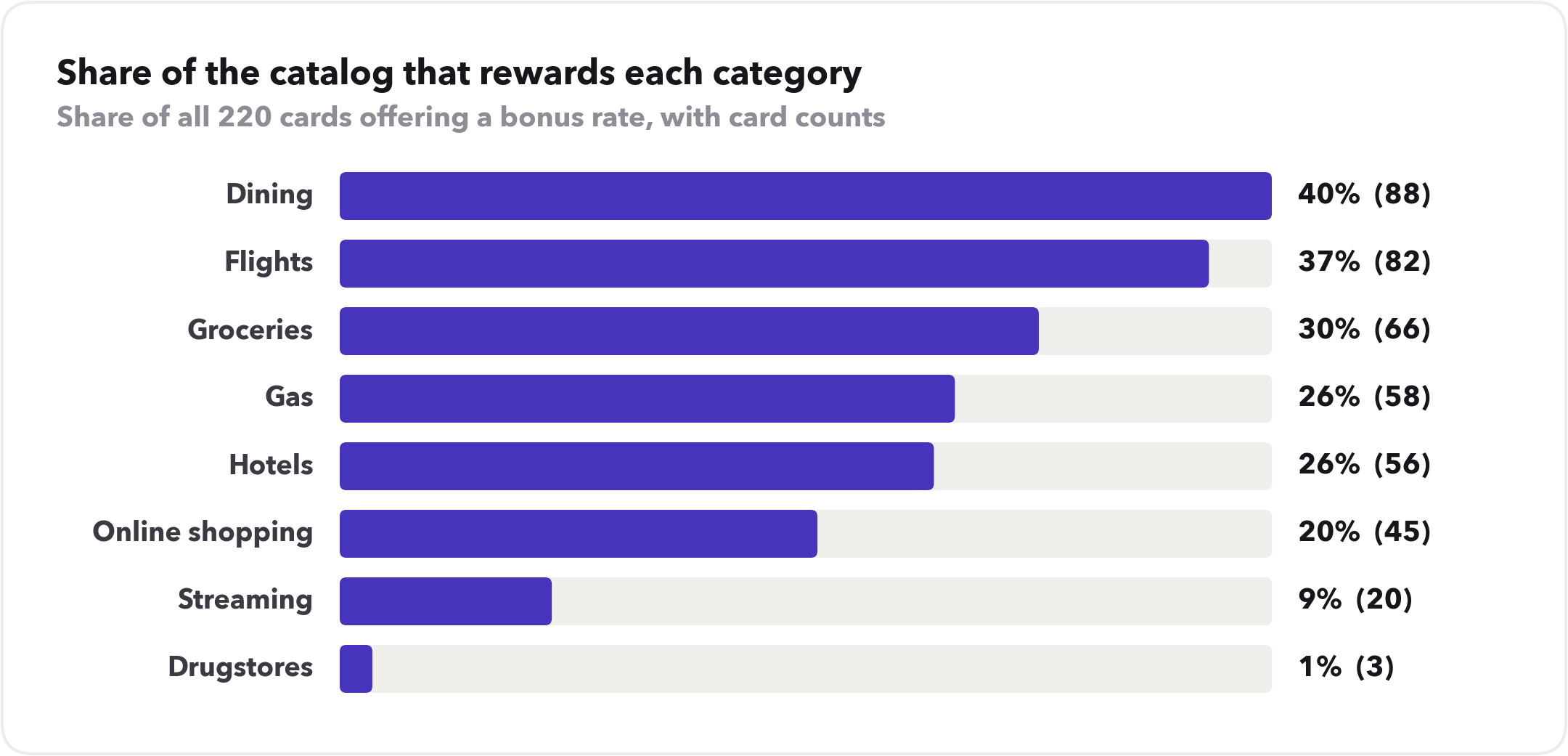
Dining is the most widely rewarded category in the market, and only 40% of cards touch it. Groceries — reliably among the largest lines in a household budget — get a bonus rate on fewer than a third. Drugstores are rewarded by three cards out of 220.
Sixty-eight cards, nearly a third of the catalog, reward no category at all. They are flat-rate products and store cards. Of the ones that do, the median card carries two categories, and only fourteen cards in the entire catalog carry five or more.
The realistic picture for someone holding one card is therefore narrow: two categories earn a boosted rate, and the rest of your spending earns whatever the card's baseline is. Whether that card is any good depends almost entirely on whether your life matches its two categories — a question the advertising never asks. Our guide to whether an annual fee card is worth it walks through running that arithmetic against your own statement.
Where the enormous numbers come from
The multipliers in the advertising are real, but they are concentrated, and some of them are constructed.
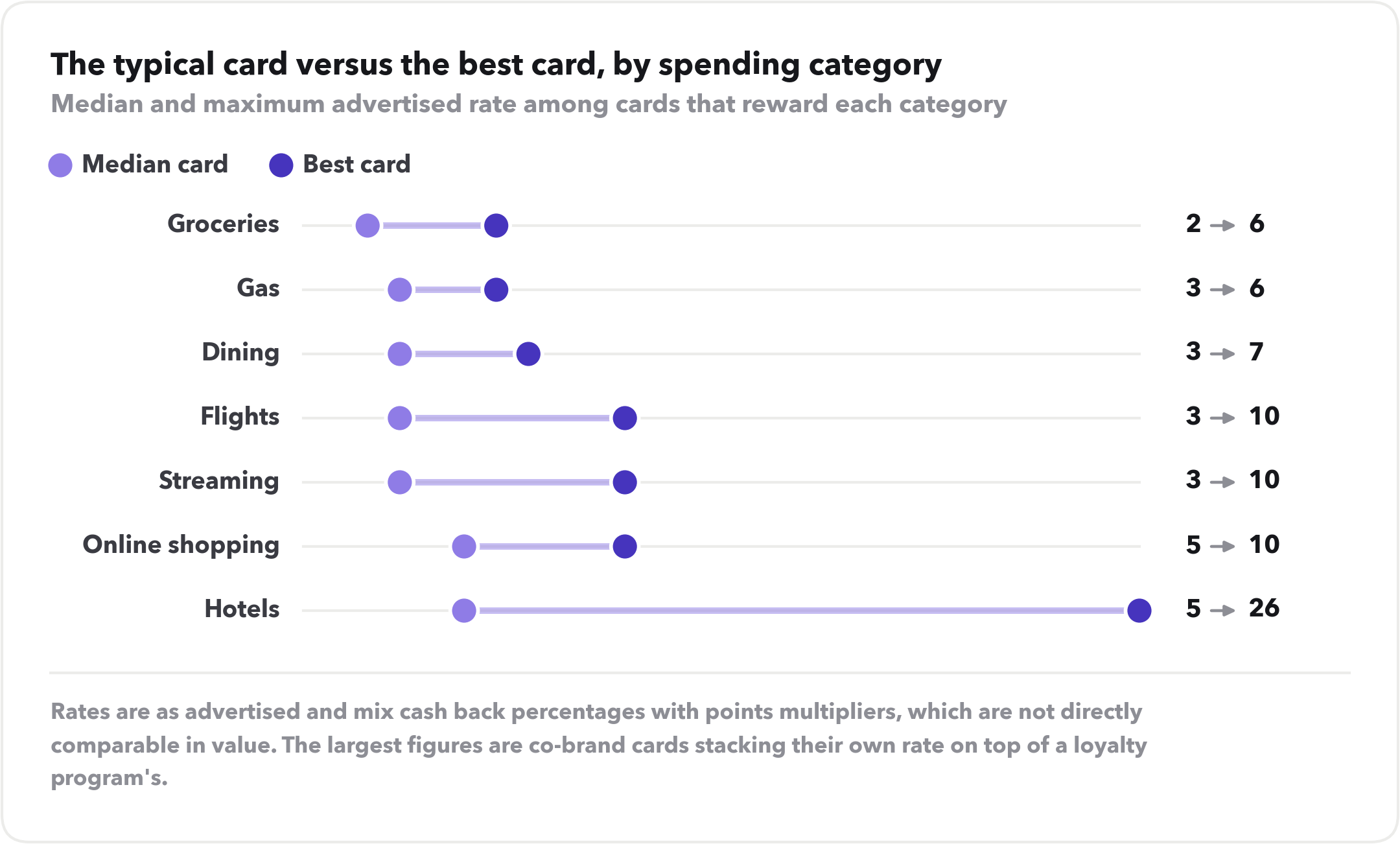
Hotels have a median of 5 and a maximum of 26. That 26 deserves a moment, because it shows how these figures are assembled. The IHG One Rewards Premier card advertises "up to 26X total points" at IHG properties. Ten come from the card. The rest come from the hotel's own loyalty program, which pays out whether you use that card or not. The card is claiming credit for the hotel chain's marketing budget.
This is legal, common and close to universal in co-brand products — which, given that 38% of the catalog is co-branded, is a large share of the biggest numbers on offer. Only sixteen cards in the catalog advertise a rate of 10x or more, and they are almost all of this kind. A 26 and a 3 in this dataset are not the same sort of number, and they should not be compared as though they were.
The tiers, side by side
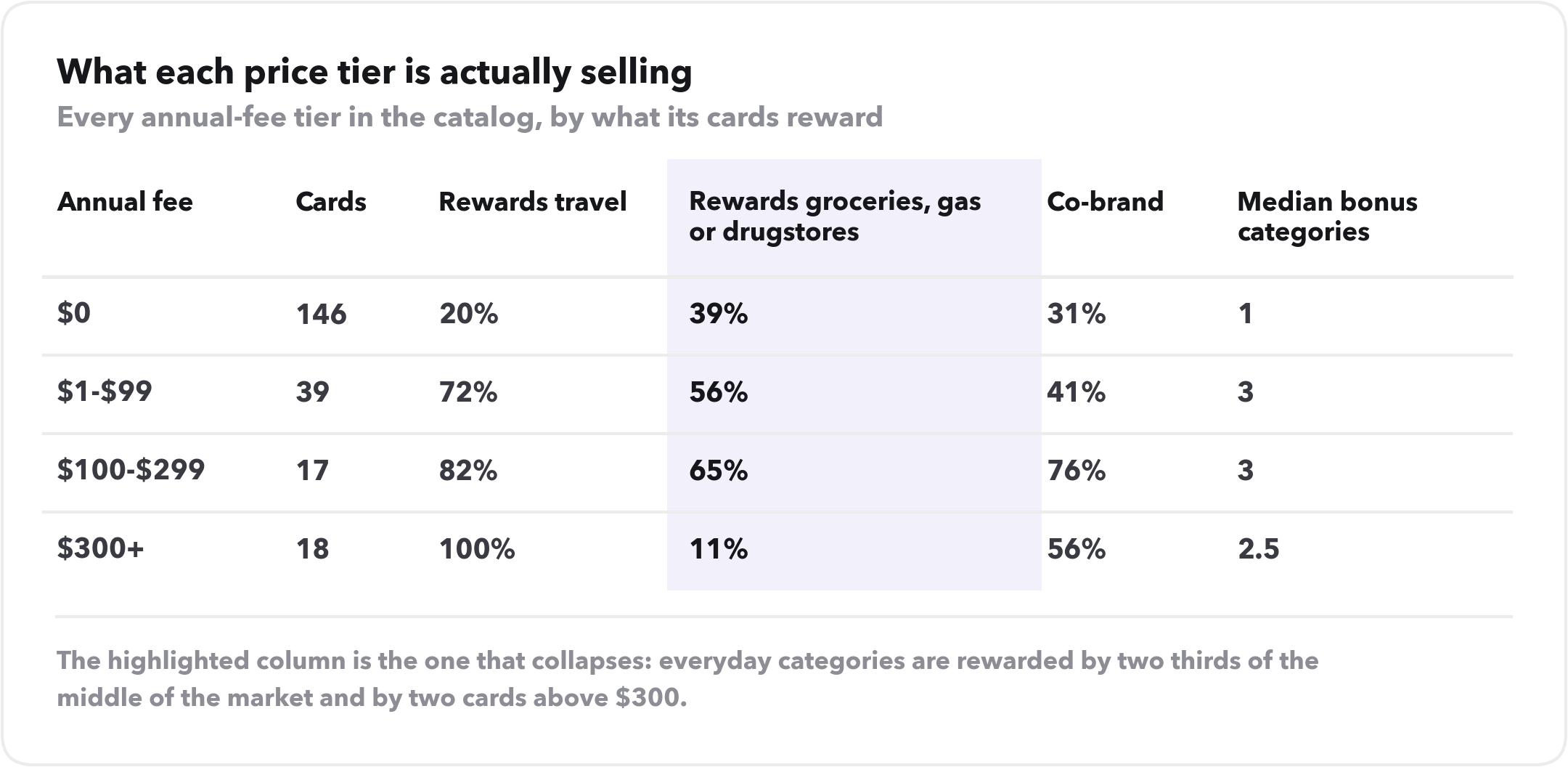
Read the highlighted column. Everyday categories are rewarded by roughly two-thirds of the cards priced under $300 and by two of the eighteen above it. Notice too that the median number of bonus categories peaks at $1–$99 and $100–$299, at three, and then falls to 2.5 in the most expensive tier. Paying $550 does not buy you a broader card. It usually buys you a narrower one, plus credits and lounge access that do not show up as an earn rate at all.
Ninety-four percent of the catalog advertises a welcome bonus, and every card above $300 does. A bonus is no longer a differentiator; it is the price of admission, a discount on the first year offered by essentially everyone. It is worth remembering when a card's pitch leads with it.
What to do with this
Work out which market you are in before you compare anything. If most of your spending happens within a few miles of your house, the premium tier is not a more powerful version of what you want — it is aimed elsewhere, and its earn rates will show that. The useful comparison set for you is a much smaller slice of the catalog than the advertising implies.
If a card carries a brand on it, price it as what it is: a discount programme for one company, which is excellent if you were already loyal to that company and mediocre if you were not. Thirteen of the seventeen cards in the mid-market are this. Our rundown of travel rewards cards covers what those points are worth once you actually try to redeem them.
And treat any rate above 10x as a claim to check rather than a number to bank. In this catalog those figures are nearly always a card rate stacked on a loyalty programme's, describing what you would earn for spending money at one company. That can be worth having. It is not a general-purpose return, and it is not what you will earn on the rest of your life.
Methodology: figures are drawn from the 220 active, approved cards in the YoungerFinance catalog as of August 2026, covering 18 issuers. Rates are as advertised by issuers and are not adjusted for point valuations, spending caps, or redemption restrictions; cash-back percentages and points multipliers are reported as published and are not directly comparable in value. A small number of source records store rates in inconsistent units — a percentage written as 0.05, or a per-gallon fuel discount recorded as a rate — and were normalized or excluded before analysis. "Rewards travel" means a card pays a bonus rate on flights or hotels; "rewards groceries, gas or drugstores" means it pays one on at least one of those three. This is a snapshot of the market as it currently stands, not a comparison against prior years.