
The Savings Account Market Report
Shopping for a savings account is supposed to be simple. There is one number on the page, and a bigger number is better.
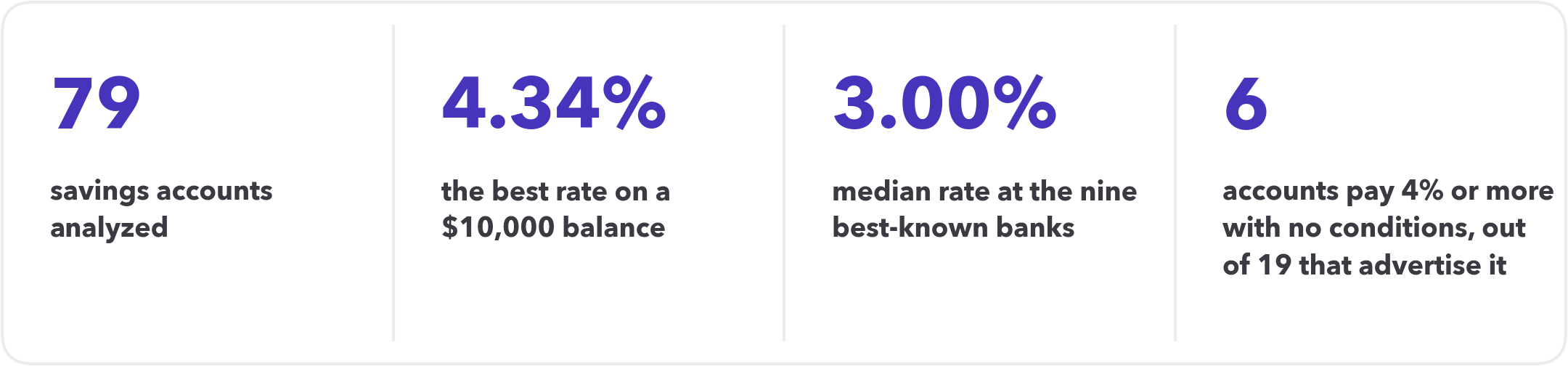
We went through the 79 savings accounts in our catalog that are open to new customers and publish a rate, and worked out what each one actually pays, rather than what it advertises. The two are different often enough that the advertised number is not much use by itself. It is frequently quoted on a balance you do not have, it usually depends on something you have to keep doing, and it often expires.
The top rates are packed very close together
Start with the shape of the market. Each dot is one account.
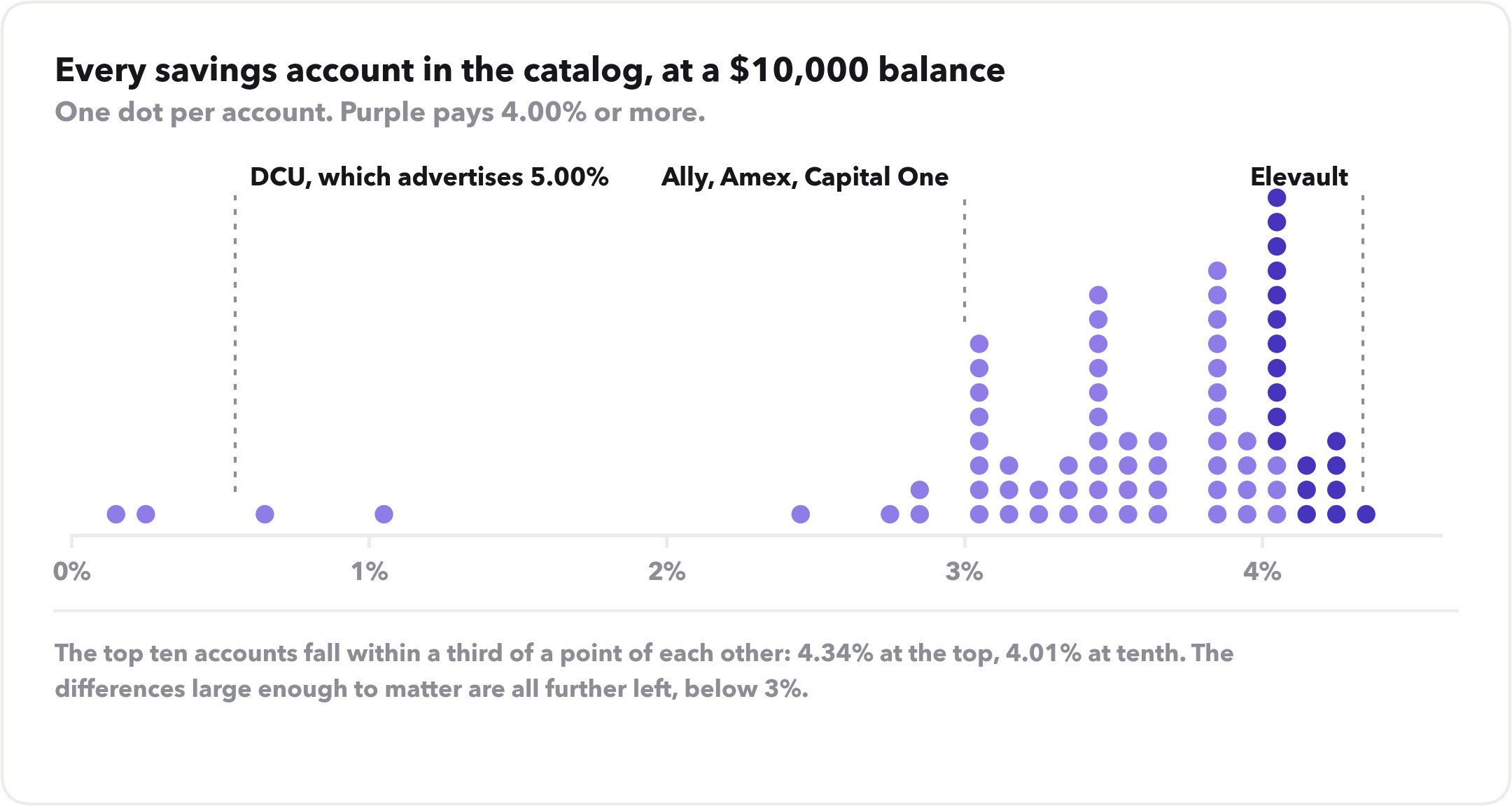
The best account pays 4.34% on $10,000. The tenth-best pays 4.01%. The top ten accounts are separated by 33 basis points — $33 a year on a $10,000 balance, or under three dollars a month.
Now look at the other end. The median account pays 3.60% and the worst pays 0.10%. The distance from the median down to the bottom is 3.50 points, more than ten times the spread across the top ten.
That is worth keeping in mind, because it means moving from a good account to the best one barely matters, while moving from a bad account to an average one matters a lot. Most of the marketing in this market is aimed at the first of those two moves.
Banks cluster their rates on round numbers
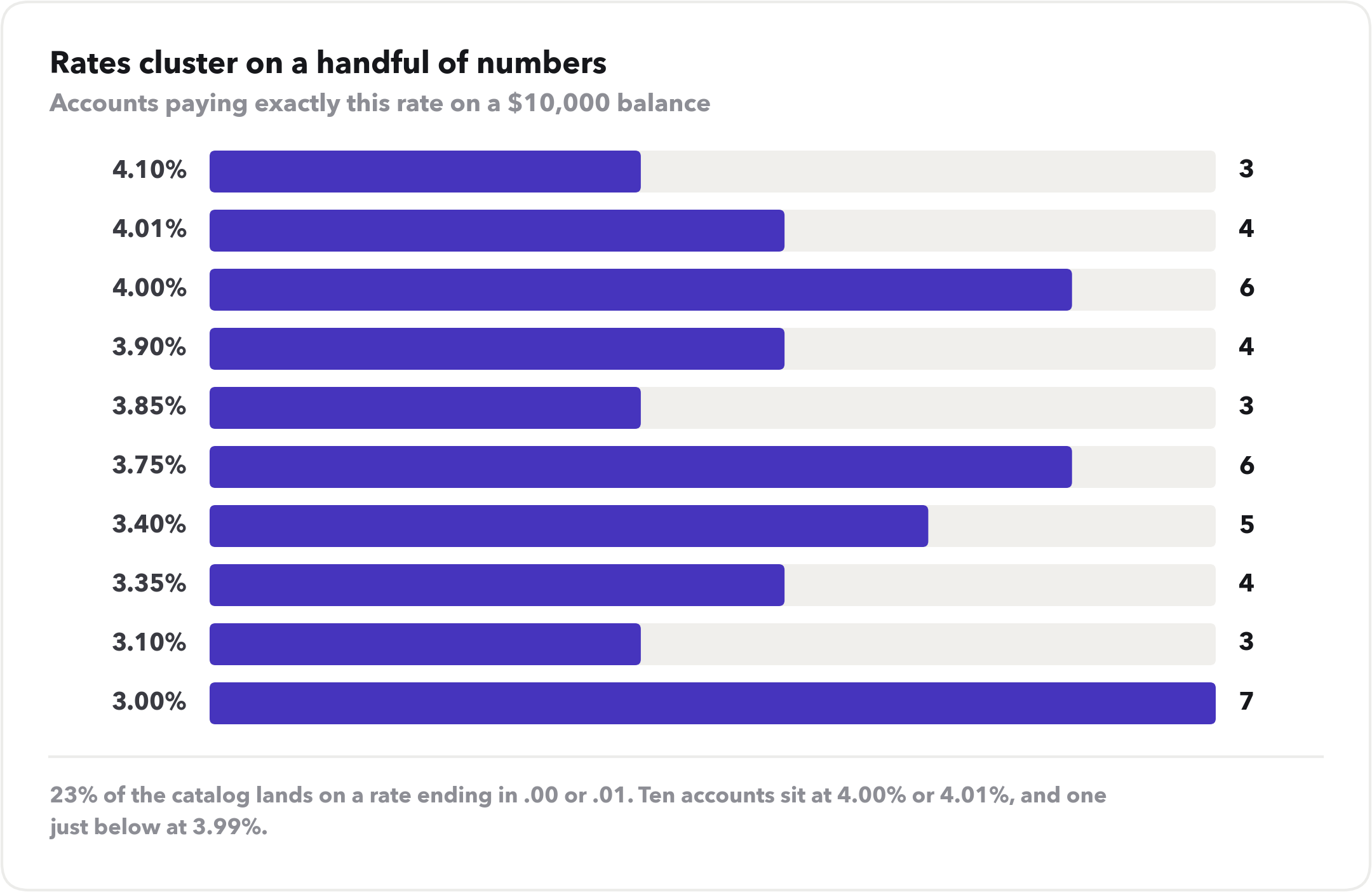
Six accounts pay exactly 4.00%, and four more pay exactly 4.01% — a hundredth of a point higher, which is enough to advertise "over 4%" and nothing else. One account, Vio Bank's Online Savings, sits just below at 3.99%. Seven accounts pay exactly 3.00%, including Ally, American Express and Capital One 360.
Nearly a quarter of the catalog lands on a rate ending in .00 or .01. That is not how a rate looks when it is set by the cost of funding. It is how a rate looks when it is set against whatever the bank next to you on the comparison table is offering — the same pattern that put seventeen credit cards on a $95 annual fee in our credit card market report.
What it takes to actually get 4%
Nineteen accounts pay 4.00% or more on a $10,000 balance. Here is what is left after applying the checks a saver would apply themselves.
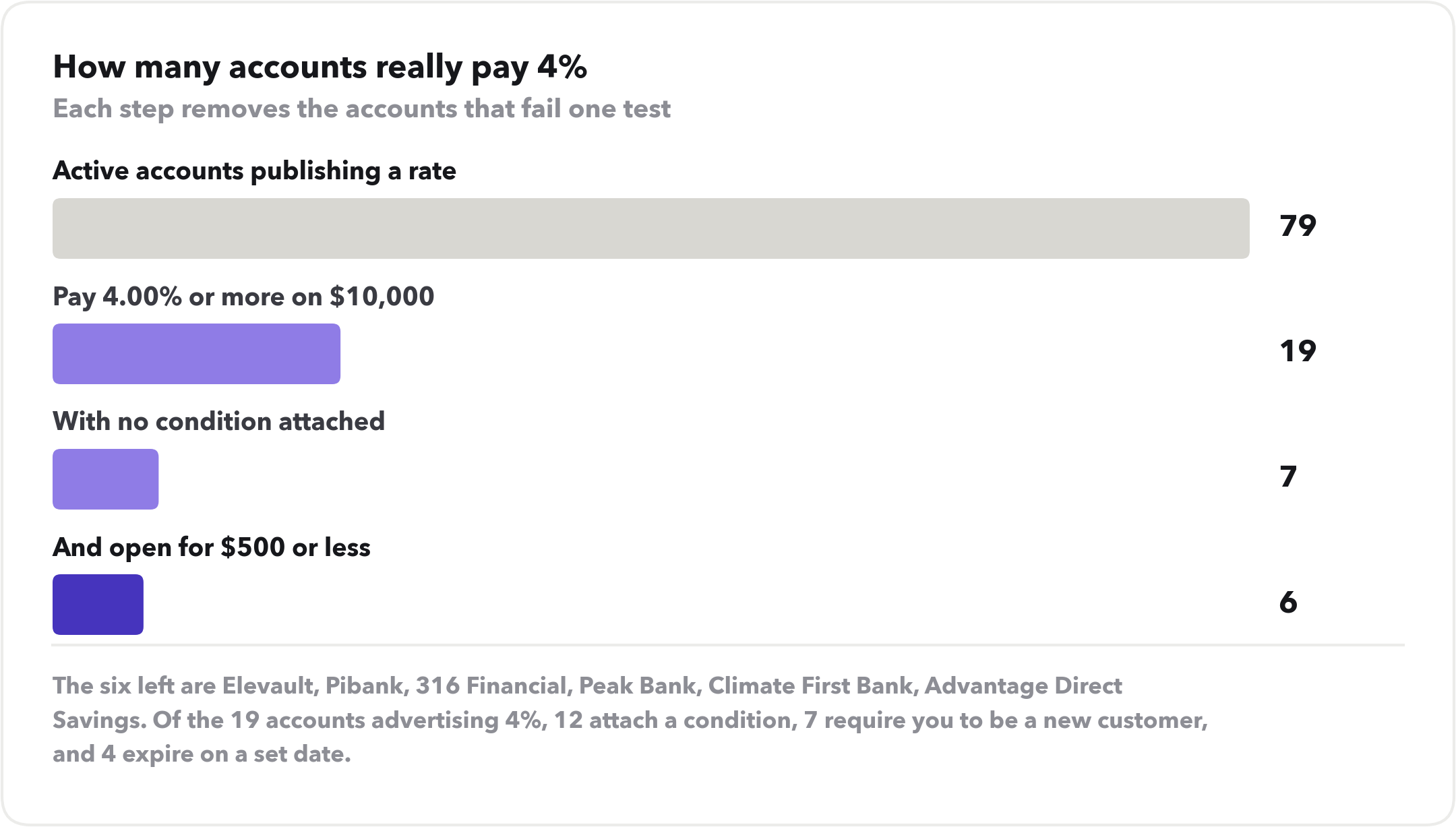
Twelve of the nineteen attach a condition. Seven require you to be a new customer, or to bring money you did not already hold there, so the rate is an offer for new business rather than the standing rate on the account. Four expire on a set date: Wealthfront's boost ends 30 November 2026, Forbright's and Bask's on 31 December, Betterment's on 15 January 2027.
Seven have no conditions attached, and six of those also open for $500 or less. That leaves six accounts paying 4% or better with nothing attached: 316 Financial, Advantage Direct Savings, Climate First Bank, Elevault, Peak Bank and Pibank. None of them is a well-known name. A seventh, Newtek at 4.20%, would qualify except that it has closed to new customers.
What happens when you stop meeting the conditions
Twenty-one of the 79 accounts tie their rate to something you have to keep doing. The more useful question is what they pay when you stop.
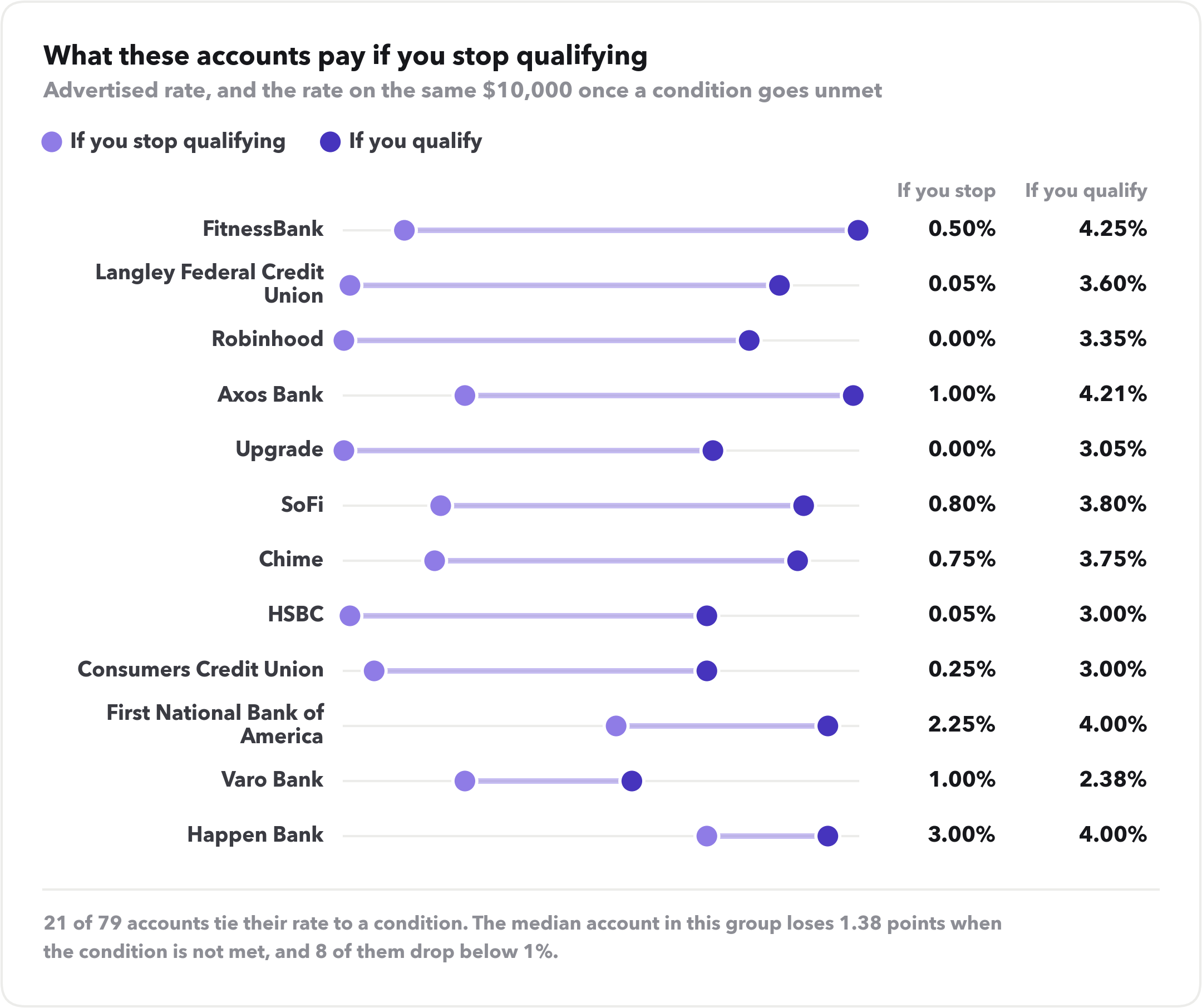
The rates do not step down gradually. The median conditional account loses 1.38 points as soon as its condition goes unmet, and eight of the twenty-one drop below 1%.
Langley Federal Credit Union is the clearest case. Its savings account pays 3.60% if you take e-statements and make no more than one withdrawal a month. Make a second withdrawal and the entire balance earns 0.05% for that period. Robinhood pays nothing at all on its cash sweep without a $5-a-month Gold subscription. FitnessBank sets your rate by your average daily step count, read from Fitbit or Apple Health: 0.50% under 5,000 steps, rising to 4.00% at 12,500.
It is worth looking at what is being asked for.
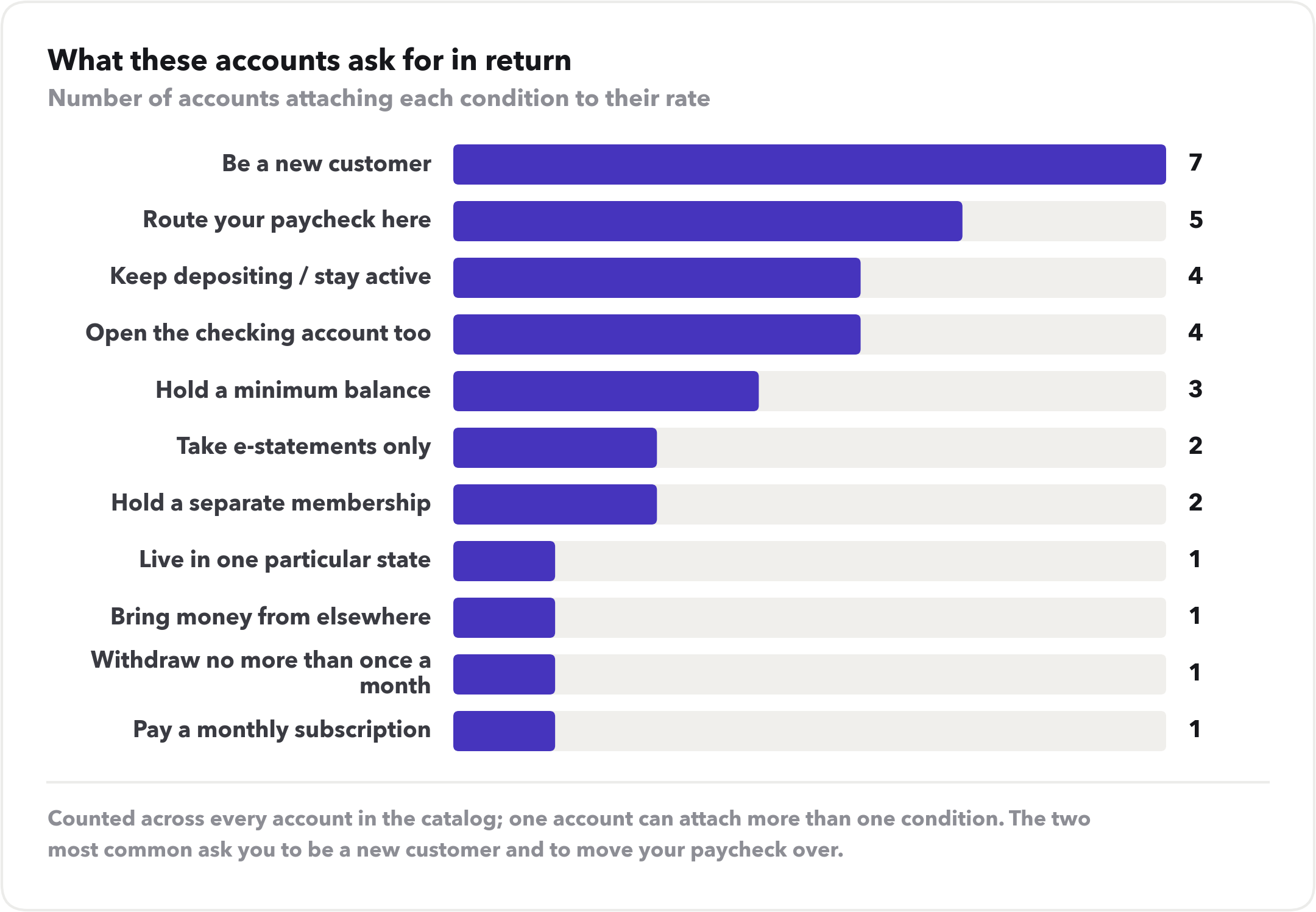
The two most common conditions have little to do with how you save. They ask you to be a new customer and to move your paycheck over. In a lot of cases the advertised rate is what the bank is willing to pay to win your account, and it goes away once you are no longer new.
Conditions attached to the rate are not the only terms worth reading. Forty-seven of the 79 accounts carry some other restriction: a cap on withdrawals, a ceiling on the balance that earns the rate, a state you have to live in, or an arrangement that folds the account into another bank's insurance limit.
The advertised rate often applies to a different balance
Six accounts advertise a rate that a $10,000 balance does not earn, because the number applies to one band of a tier ladder rather than to the whole balance.
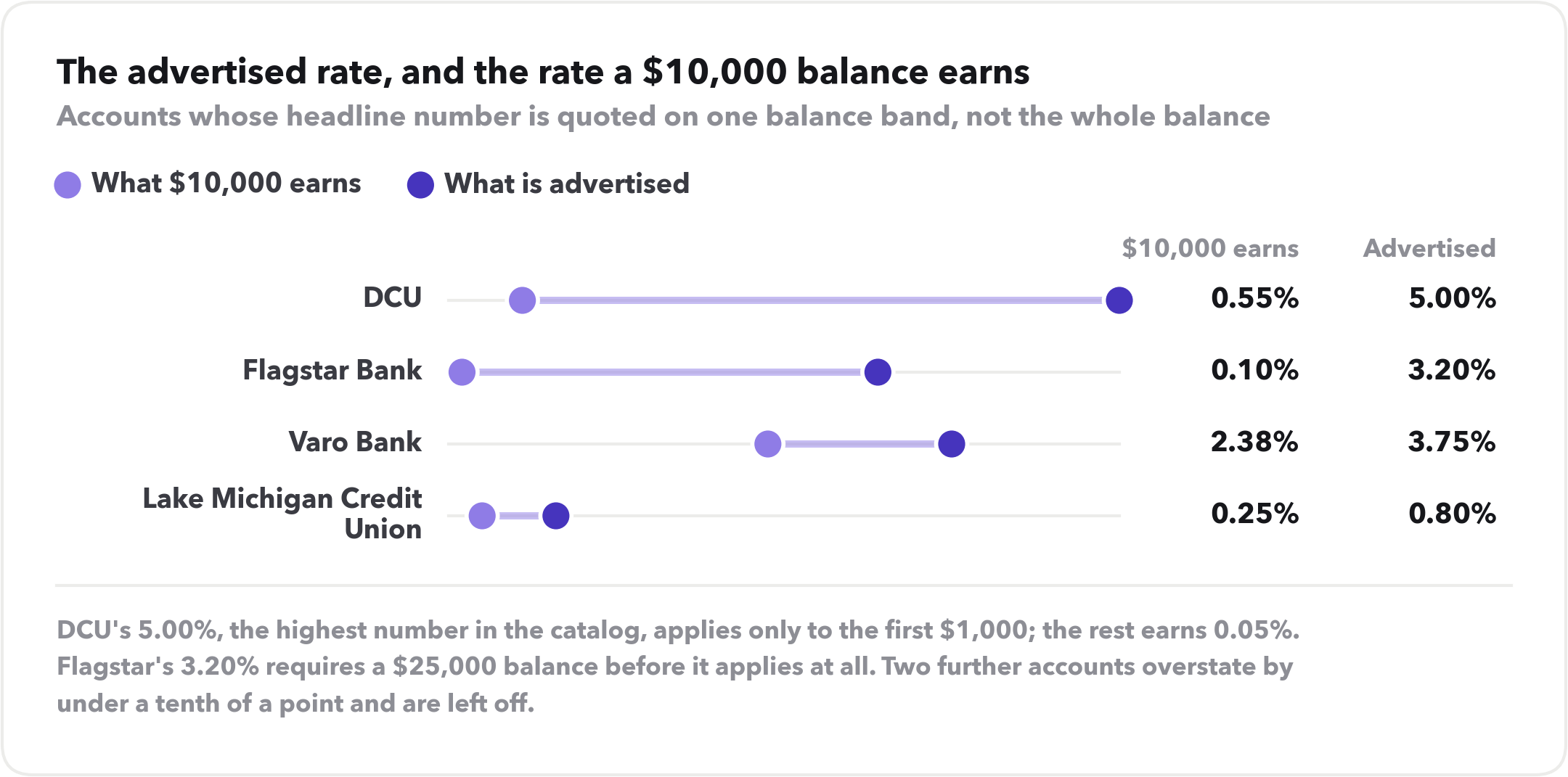
DCU advertises 5.00%, the highest number in the catalog. It applies to the first $1,000. Everything above that earns 0.05%, so $10,000 blends out to 0.55% and $250,000 to 0.07%. Flagstar works the other way round: below $25,000 its account pays 0.10%, so its advertised 3.20% is out of reach for most of the people who see it.
Both figures are accurate, and neither tells you what you would earn on your own balance. Trace the same accounts across four balances and the ordering changes completely.
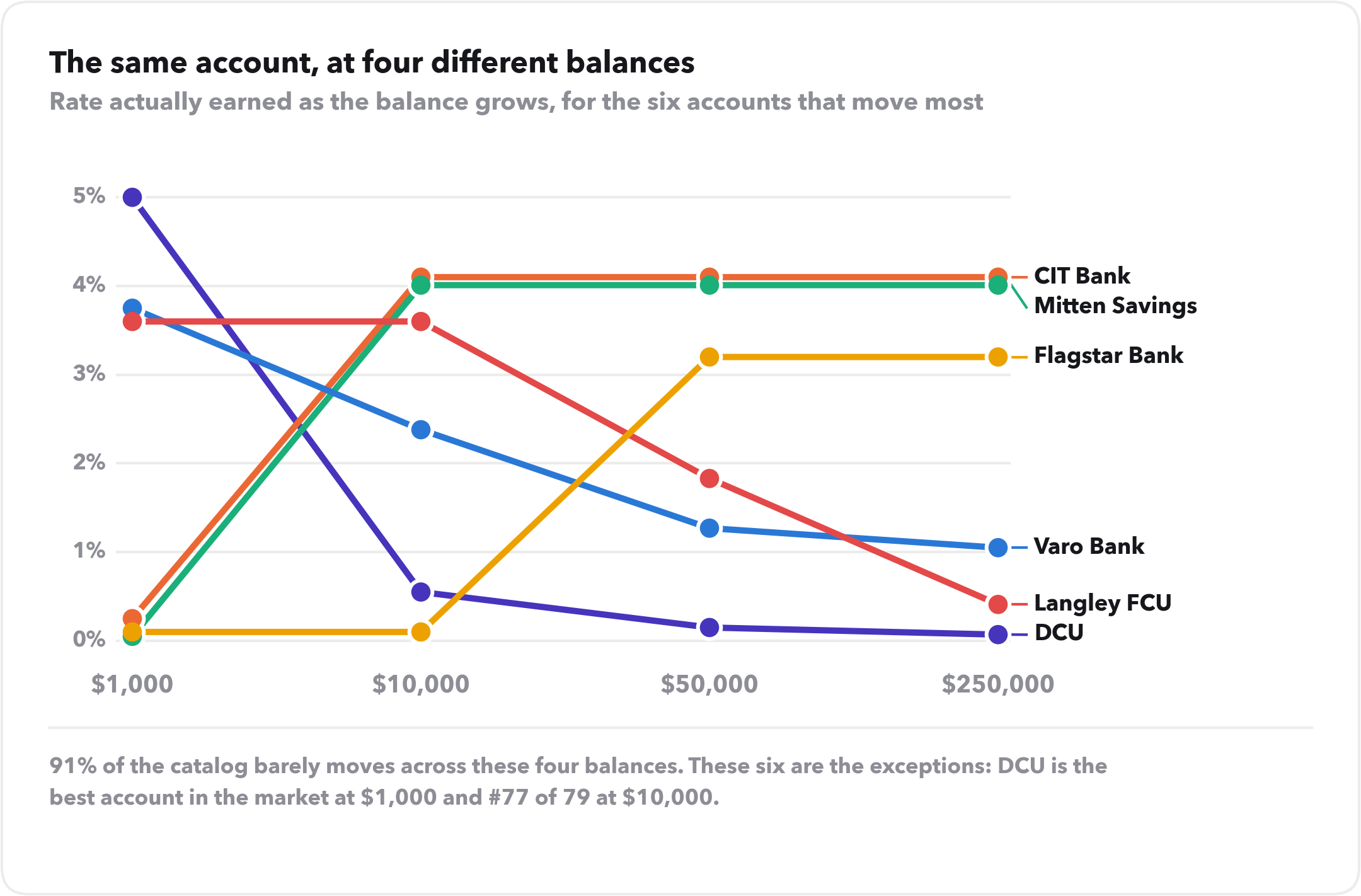
DCU is the best account in the market at $1,000 and 77th of 79 at $10,000. Mitten Savings is last at $1,000 and thirteenth at $10,000. CIT Bank moves from 76th to sixth. Wealthfront sits fourth at $10,000 and $50,000, then falls to 22nd at $250,000, because its promotional boost stops applying above $150,000.
This is a small group rather than a general pattern: 91% of the catalog barely moves across those four balances. But these are the accounts whose headline numbers are large enough to reach the top of a comparison table, which is where most people meet them.
The best-known banks pay the least
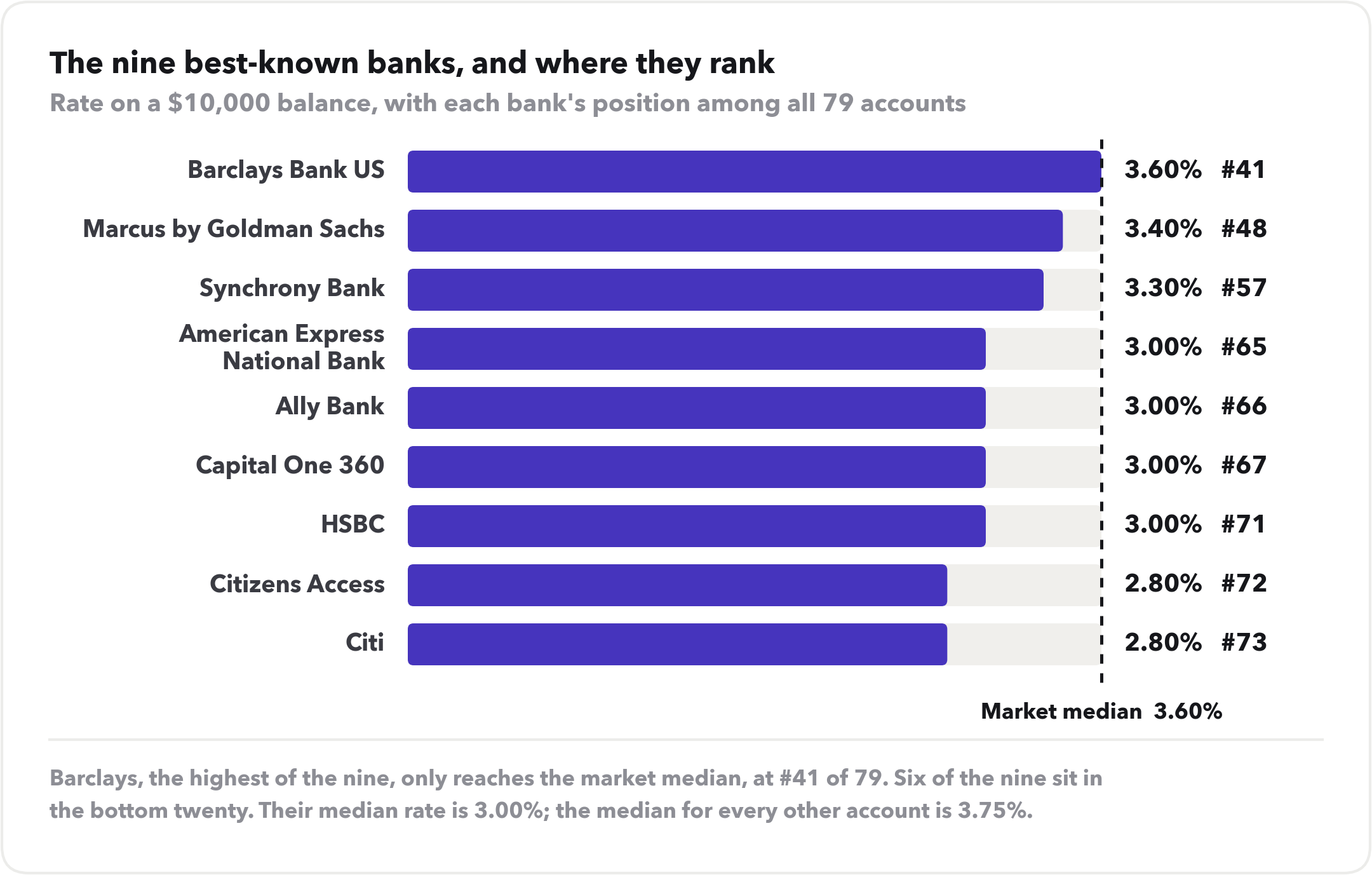
Nine institutions in this catalog run a savings brand most people could name. Their median rate is 3.00%. The median for every other account is 3.75%.
None of the nine appears in the top twenty. Barclays, the highest of them, only reaches the market median, at 41st of 79. Six of the nine sit in the bottom twenty of the whole catalog. Citi and Citizens Access pay 2.80%.
Grouped by type of institution, the same pattern shows up with more detail.
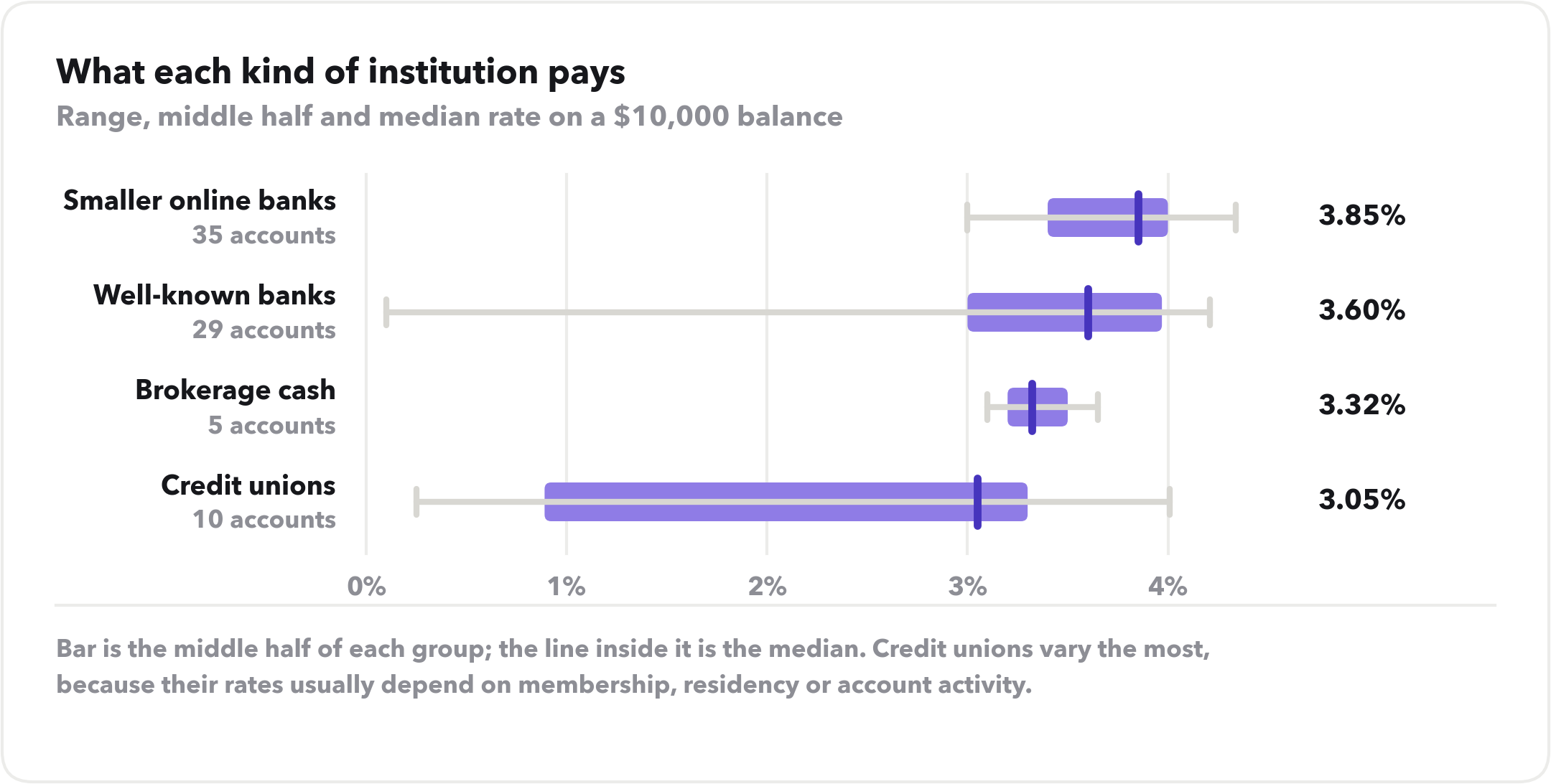
The banks most people have not heard of pay the most and vary the least: 35 accounts, a median of 3.85%, and a floor of 3.00%, which is what the big banks pay on average. Credit unions vary the most — half of them fall between 0.89% and 3.30%, a band two and a half times wider than any other type, and the group runs from 0.25% up to 4.01%. Their headline rates almost always depend on membership, residency, activity or a balance band. Brokerage cash accounts sit low and close together, at a median of 3.32%.
The difference between a familiar bank and an unfamiliar one is 0.75 points, or $75 a year on $10,000.
Who is actually holding your money
Twenty-nine of the 79 accounts are a brand operating on top of a different bank, and some banks run several.
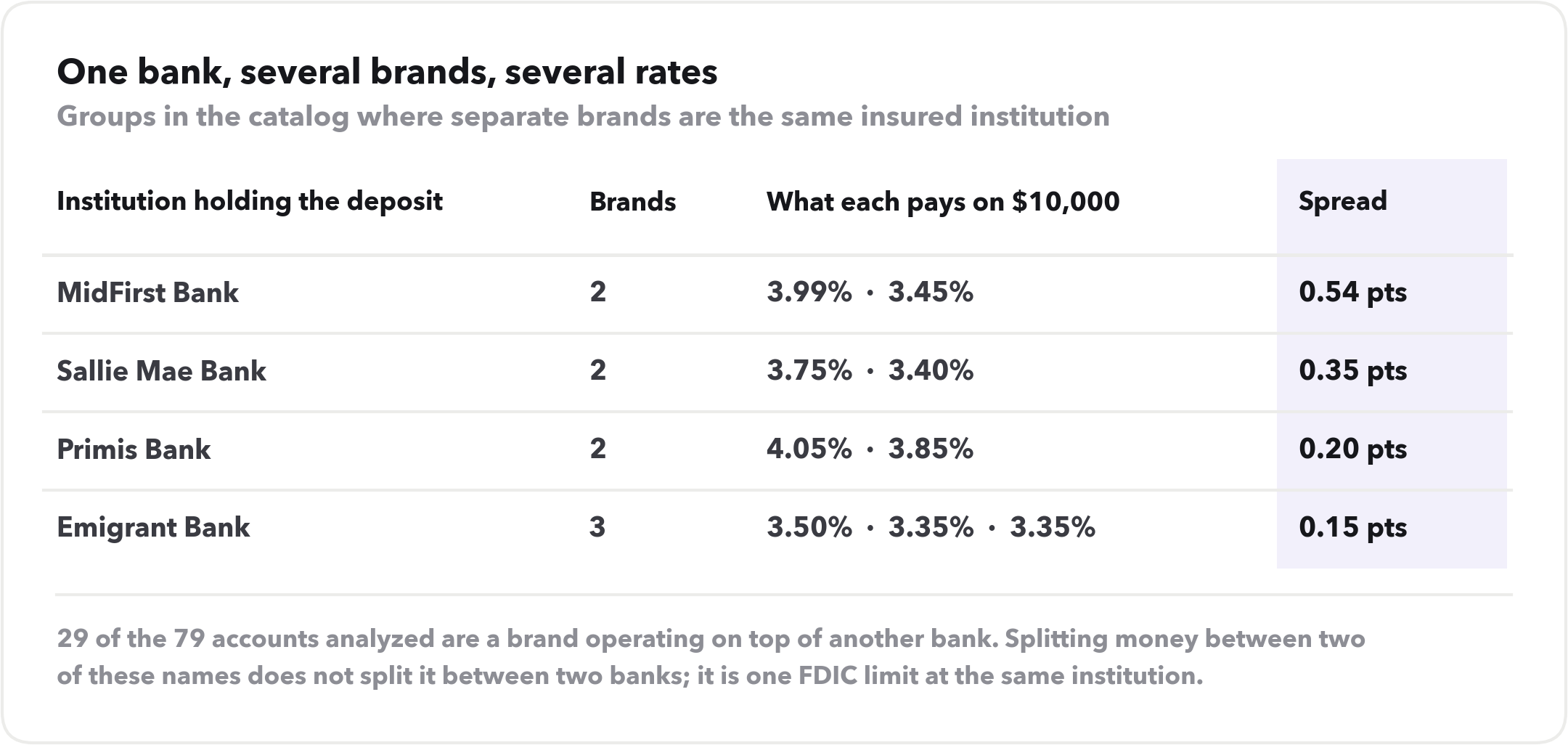
Vio Bank sells two savings products. Both are MidFirst Bank, both open at $100, and they are 0.54 points apart. Emigrant Bank runs three separate consumer brands. Sallie Mae Bank runs SmartyPig at 35 basis points below its own name.
That matters for two reasons. The brand sets the rate more than the bank does, so the "different bank" you switched to may be the same institution at a better number. And splitting a large balance across two of these names does not double your FDIC coverage, because it is one limit at one bank.
Nine accounts here are not banks. Wealthfront, Betterment, SoFi, Chime, Robinhood, Public, M1, Upgrade and OnePay hold deposits at partner banks and pass FDIC coverage through, which works differently from holding an insured account directly. Two more — Vanguard's VMFXX at 3.65% and Fidelity's SPAXX at 3.32% — are money market funds. They show up on savings comparison tables constantly, but they carry SIPC protection rather than deposit insurance. Our guide to where each pile of cash belongs covers which of these suits an emergency fund.
What the difference is worth in dollars
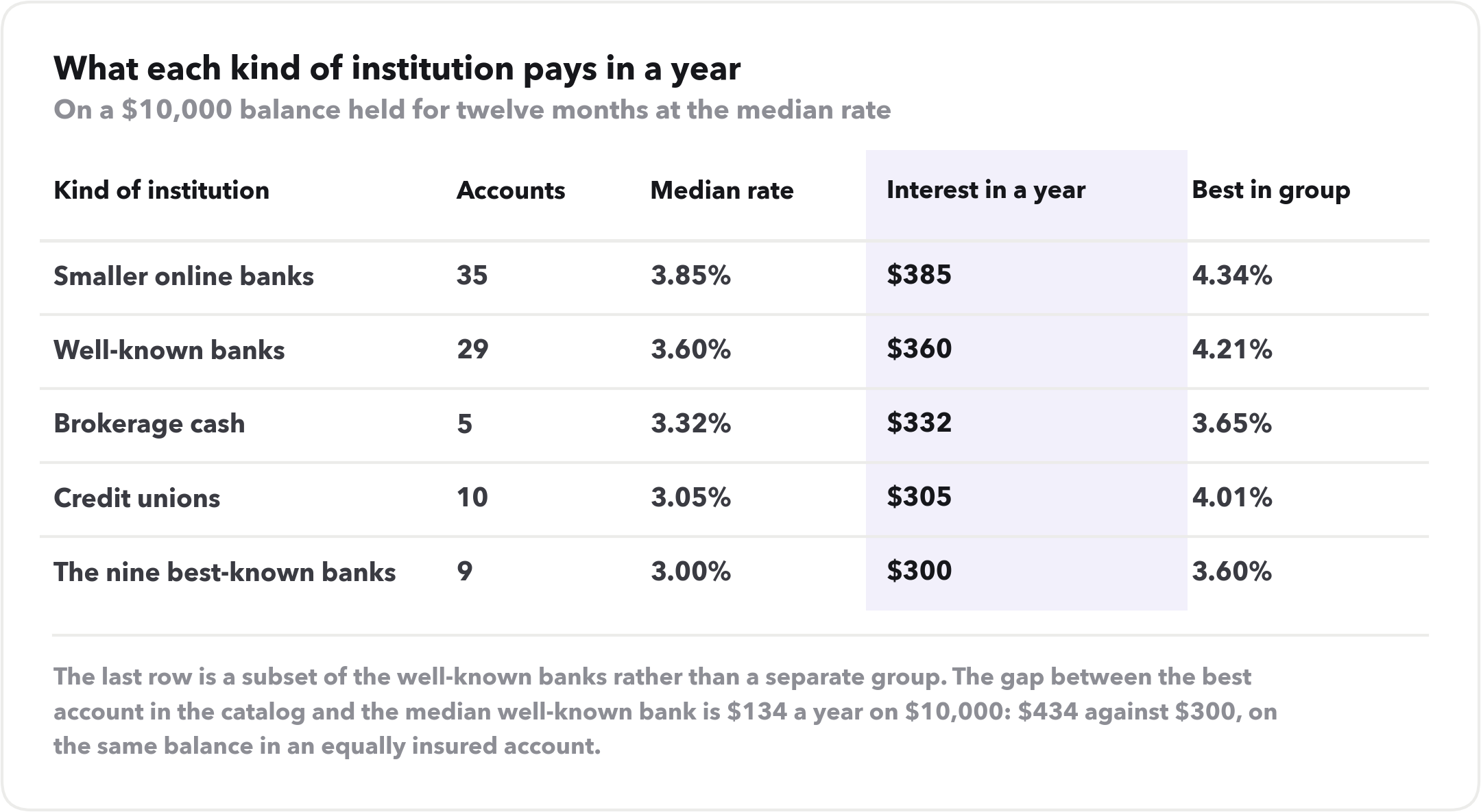
On a $10,000 emergency fund held for a year: $434 at the best account in the catalog, $401 at the tenth-best, $360 at the median, and $300 at the median well-known bank.
The gap between first and tenth is $33. The gap between tenth and the bank you have probably already opened an account with is $101. Almost all of the competition happens across the smaller of those two gaps.
What to do with this
Pick something near the top and leave it. Anything paying 3.90% to 4.10% is within $45 a year of the theoretical best on a $10,000 balance. Chasing anything beyond that is not worth the effort, and the leader changes month to month anyway.
Check three things before opening an account: what balance the advertised rate applies to, what you have to keep doing to hold it, and when it expires. Those three questions rule out twelve of the nineteen accounts advertising 4%.
Assume a conditional rate will lapse at some point. The conditions are built around things that change — a direct deposit that follows a job, a withdrawal limit that meets an emergency, a promotion that ends in November. Compare accounts on what they pay when the condition is not met, and treat the boost as extra.
Look up the bank behind the brand. If your balance is large enough for insurance limits to matter, find out which institution actually holds the deposit. And if earning the advertised rate requires opening a checking account, moving a paycheck or hitting a step count, count that as part of what it costs you.
If your savings are at one of the nine banks on that chart, moving them is the change that makes the biggest difference, and it is worth more than any further optimizing afterwards. Our current rundown of where savings rates stand covers what the Fed is likely to do to these numbers, and the full comparison tool lets you re-sort this catalog at your own balance, which as the balance chart above shows can change the answer.
Methodology: every figure in this report is computed on the 79 savings and cash accounts in the YoungerFinance catalog that are open to new customers and publish a rate, verified between 26 and 30 August 2026. Every rate in this report is derived from the account's stored rate mechanism — its tier ladder, its qualification gate and its boosts — rather than from a stored headline APY, using the same code that ranks the public comparison tool. Unless stated otherwise, "rate" means the blended APY a $10,000 balance actually earns, assuming the saver meets conditions a motivated person could meet (a direct deposit, e-statements) and not those they cannot (a state residency requirement, a $50,000 minimum they do not have). Tiered ladders are computed as marginal or threshold according to how each provider prices them; treating one as the other misprices most of the credit unions. The nine best-known banks are a hand-picked list — Ally, American Express, Barclays, Capital One 360, Citi, Citizens Access, HSBC, Marcus and Synchrony — and are the one judgement call in the analysis; fintechs are excluded because they are not banks and price differently. Rates are as published by each provider and move frequently. This is a snapshot of one market at one moment, not a comparison against prior years.