Rent is probably the biggest line item in your budget, and for most people it's the one purchase that earns nothing. Pay it through a third-party service and you'll typically hand over about 3% in fees — on $2,000 rent, that's $60 a month to earn maybe $40 in rewards. The math has never worked.
Bilt is the exception. It's the one program that lets you pay rent or a mortgage with a credit card and pay no transaction fee, ever. That's a genuinely unusual product, and it's why people ask whether the Bilt card is worth it. But Bilt rebuilt the whole thing in January 2026, and the new version answers that question very differently depending on how much you spend on everything else.
What changed with the Bilt card in 2026
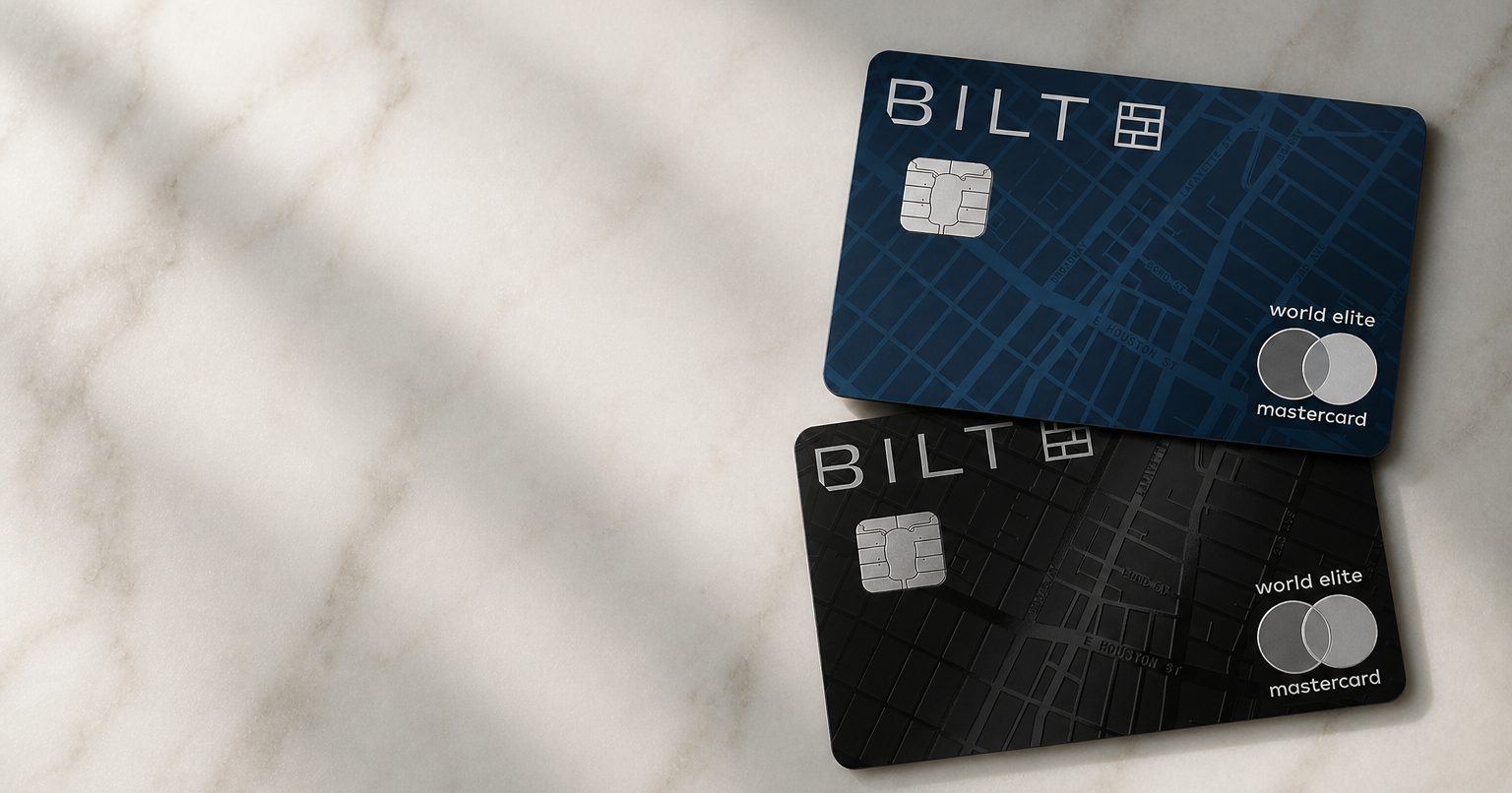
The old Bilt Mastercard — the Wells Fargo one, with the five-transactions-a-month rule and a 100,000-point annual cap on rent — is gone. In January 2026 Bilt replaced it with three cards issued by Column N.A. on the Mastercard network and serviced by Cardless:
- Bilt Blue — $0 annual fee, 1X points on everyday spend, $100 in Bilt Cash for getting approved
- Bilt Obsidian — $95 annual fee, up to 6X at partner restaurants, 3X on a grocery category you pick
- Bilt Palladium — $495 annual fee, 2X on everything, travel perks, a larger welcome offer
The 100,000-point rent cap is gone, which sounds like an upgrade. But Bilt also replaced flat rent earning with a formula, and that formula is the whole story now.
Your rent points depend on your other spending
Bilt calls it the Everyday Spend Ratio: how much you put on the card in normal purchases each month, measured against your housing payment. Hit a threshold, unlock a rate.
| Everyday spend vs. your rent | What rent earns |
|---|---|
| Under 25% | Nothing |
| 25% | 0.5% back |
| 50% | 0.75% back |
| 75% | 1% back |
| 100% or more | 1.25% back |
Read that top row again, because it's the part that catches people. If your rent is $2,000 and you put less than $500 a month of other spending on the Bilt card, your rent earns zero. Not a reduced rate — nothing.
To get the headline 1.25%, you need everyday spending that equals your entire rent payment. On $2,000 rent, that's $2,000 a month — $24,000 a year — in groceries, gas, dining, and bills routed through this one card. That's a big ask for the renters Bilt is aimed at.
There's a second mode if you prefer: take 4% back in Bilt Cash on everyday purchases instead of points, then spend that Bilt Cash to unlock rent points at a cost of about 3% of the payment. It's the same trade-off wearing a different hat — you're still funding rent rewards out of your other spending. Worth knowing: Bilt Cash balances above $100 expire once a year, so it's use-it-or-lose-it.
The math against a plain 2% card
Here's the honest comparison. A flat 2% cash back card earns double Bilt's 1% base on everyday purchases — but it earns nothing on rent, because paying rent with it costs a fee that wipes out the reward. So the question is whether Bilt's rent points cover the gap.
Take $2,000 a month in rent, $24,000 a year, and run three realistic spenders on the Bilt Blue:
Heavy user — $2,000/month in other spending. Everyday spend earns $240. Rent hits the 1.25% tier for $300. Total: $540. The same $24,000 on a 2% card earns $480. Bilt wins by $60.
Moderate user — $1,000/month. Everyday earns $120. Rent hits 0.75% for $180. Total: $300. A 2% card on the same $12,000 earns $240. Bilt wins by $60.
Light user — $400/month. Everyday earns $48. Rent falls under the 25% floor and earns nothing. Total: $48. A 2% card earns $96. Bilt loses by $48.
The pattern is clearer than the marketing: as long as you clear the 25% threshold, Bilt comes out ahead of a straight 2% card — but the margin is modest, roughly $60 a year in these scenarios, not the windfall the pitch implies. Fall below the threshold and you've traded a 2% card for a 1% card and gotten nothing back. If you're weighing that trade-off, our roundup of the best flat-rate cash back cards is the benchmark to beat.
One more thing the table doesn't capture: Bilt points transfer to airline and hotel partners, which a cash back card can't do. If you actually redeem for travel, that flexibility has real value. If you were going to take the cash anyway, it doesn't.
Who should actually get it
Get the Bilt Blue if you rent, you'll route most of your spending through one card, and you'll hit at least the 50% ratio without contorting your budget. It's $0 annual fee, so the downside is limited to the small gap versus a 2% card — and the $100 in Bilt Cash for getting approved covers a year of that on its own. Pay rent through the Bilt app, keep an eye on the ratio, and it quietly beats the alternative.
Skip it if your rent is large relative to your spending. This is the common case for anyone in an expensive market: $3,000 rent and $600 of monthly card spend puts you at a 20% ratio, under the floor, earning nothing on the thing you signed up for. It's also the wrong card if you already have a good category setup you'd have to dismantle — moving grocery and dining spend off a 3% or 5% card onto Bilt's 1% to chase a 1.25% rent rate is a losing trade.
Think hard about the annual-fee versions. The Obsidian at $95 needs about $7,600 of restaurant spending at its top rate to break even on the fee alone, and the Palladium at $495 only makes sense if you'll use the travel benefits. The rent mechanics are identical across all three — paying more doesn't get you a better rent rate, only better everyday categories.
The fairest way to read Bilt in 2026 is that it stopped being a rent card and became a normal rewards card with a rent bonus attached. That's less exciting than the original pitch, but it's still the only no-fee way to put housing on a credit card, and for a renter who consolidates spending, it's worth having. Just run your own ratio before you apply — take your monthly rent, take what you honestly charge in a month, and divide. That number, not the 1.25%, is what the card is worth to you.
A last note that matters more than the rewards: none of this works if you carry a balance. Putting a $2,000 rent payment on a card at a typical APR and paying it off over a few months costs far more in interest than any of these rates return — the math on how credit card interest works is worth a look if you've never run it. Rent on a card is a rewards play for people who pay in full every month, and a debt trap for everyone else. If cash flow is the reason the idea appeals to you, the card isn't the answer.